Dr. Clement Bezold, Chairman of The Institute for Alternative Futures
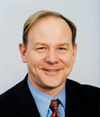 This week, Mark and Margaret speak with futurist Dr. Clement Bezold, co-founder and Chairman of the Institute for Alternative Futures. Dr. Bezold outlines his report on the future of health care in America, based on long term analysis of the impact of technology, genomics and health industry reform.
(Music)
Mark Masse ll i: This is Conversations on Health Care . I am Mark Masselli.
Margaret Flinter: And I am Margaret Flinter.
Mark Masse l li: Well Margaret, there is a lo t of buzz in Washington over the
st
l ooming start of open enrollment for the insura nce exchanges . October 1 is the
first day, but it's also the start of the new fiscal year for the federal government.
Margaret Flinter: Well, the countdown has begun on both counts and some
Republicans in Congress are making good on threats to find a way to def u nd
ObamaCare by holding up approval of the federal budget.
Mark Massel l i: And there are targeted efforts underway in a number of states to
find ways to block funding of the Health Care Law . But in spite of this lingering
opposition, the law i s moving forward.
Margaret Flinter: Well that’s great news, because the y are such uncha rted
waters for a lot of states, Mark, states that in particular had to update antiquated
systems so th at departments that oversee Medicaid can communicate with
revenu e service departments. It's to be expected there will be some growing
pains as these systems get off the ground.
Mark Masselli: Speaking of Medicaid, there will be an expanded eligibility for
Medicaid coverage under the Affordable Care Act including fol ks with incomes up
to 138% of the federal poverty line. But an interesting study was done on who
will be taking advantage of the Medicaid expansion.
Margaret Flinter: Well, that’s right , Mark . And the Kaiser Family Foundation
which has done such a grea t job in this area did a study and found that those
taking advantage of expanded Medicaid are likely to be younger white males,
and that’s a group that ’ s generally healthier than the typical Medicaid recipient.
Mark Masselli: Very interesting. And the s tudy also show ed that the average
age of Medicaid recipients is going to drop by three years from 39 years to 36
years of age.
Margaret Flinter: Well, another interesting aspect of this young adult population
is that they are definitely more comfortable consuming products online and
shopping online and interacting via mobile devices. So as we see this generation
going into the health insurance exchanges , it may feel more natural to them , it
may also help propel the advance of mobile health and telemedici ne protocols.
Our guest today is somebody who is practiced at the art of predicting and gazing
into the future . Futurist Dr. Clement Bezold is the Chairman and Co - Founder of
the Inst itute for Alternative Futures, a leading research organization that make s
long - term predictions on what the future , and in this case , the health care of the
future is going to look like.
Mark Masselli: He will be talking about his organization’s latest report on what
health care is going to look like in this country in the y ear 2025 and beyond. He
will also look into the growing impact technology is going to have on health care
delivery.
Margaret Flinter : And FactCheck.org’s Lori Robertson uncovers the truth behind
yet another misstatement from the campaign trail regarding health care.
Mark Masselli : But no matter what the topic, you can hear all of our shows by
Googling CHC Radio.
Margaret Flinter : And as always , if you have a comment , email us at
www.chcradio.com , or send a mes sage on Facebook at Conversations on Health
Care; we love to hear from you.
Mark Masselli : We will get to our guest Dr. Clement Bezold in just a moment b ut
first , here is our producer Marianne O'Hare with this week’s Headline News.
(Music) Marianne O'H are: I am Marianne O'Hare with these Healthcare Headlines .
Counting down the days towards the October 1
st
start date for open enrollment of
the online health insurance exchanges and (3:11 inaudible) there is plenty of opposition or downright confusion ab out how the Affordable Care Act is going to affect the average American. In a recent USA Today pew poll , it revealed folks
are still unsure about whether the Health Care Law is a good thing. 53% of those poll ed are still op posed to the Affordable Care Ac t while 42% poll ed think the law
is a good idea , a nd many are just playing confused about what the law requires.
56% of the young adults poll ed didn’t know the law made insurance cover age
mandatory for all Americans , and nearly four in 10 of those uninsur ed folks polled
understood that they w ould be required to gain coverage as well.
Meanwhile the insurance exchanges , those online health insurance
marketplaces , do go live October 1
st
. The Department of Health and Human
Services ha s d oled out grants to co mmunity health organizations and other
groups to help spread the word about how to navigate the online exchanges. These so - called navigators are being certified in how to assist consumers in
choosing health plans that are right for their families and thei r budgets. There
are still navigators on the ground in most states and the markets go live October 1
st
. Observers feel it's going to be far more of a soft launch with most of those
expected to purchase coverage between January and March.
From the Medica l realms , antibiotic - resist ant infections continue to be a deadly
force to be reckoned with. The CDC reports at least 2 million people fall ill each
year with antibiotic - resistant infections and 23,000 people die from those
infections. The number of actu al deaths from infections is lower than earlier
estimates largely because this study took into account other factors that might
have played a role in patient deaths. In 2007, the CDC estimated the number of
deaths was closer to 100,000 per year. This mor e rigorous study should set a
more reliable baseline. I am Marianne O'Hare with these Healthcare Headlines .
(Music)
Mark Masselli: We are speaking today with Dr. Clement Bezold , Co - Founder,
Chairman , and Senior Futurist at the I nstitute for Alternative Futures , which was
formed in 1977 , to encourage anticipatory democracy and to analyze global
trends, particularly in the future of health care and other social issues. Dr.
Bezold is the author of more than 10 books as well as the author of numerous
forec ast s and research papers and is the consulting editor of the Journal of
Futures Studies. Dr. Bezold, w elcome to Conversations on Health Care .
Dr. Clement Bezold : Thank you , m y pleasure .
Mark Masselli: Dr. Bezold, you founded the Institute for Alternat ive Futures along
with the noted author of Future Shock, Alvin Toffler . That groundbreaking book ,
published in 19 70, analyzed how society is undergoing an enormous structural
change and this accelerated rate of technological and social change i s really
qu ite overwhelming to the society. Technology is revolutionizing so many
aspects of our lives, especially in the delivery and use of health care. Help us
understand the key ideas of Future Shock and the changes in technology as it
relates to health care.
Dr. Clement Bezold : Yeah . Alvin Toffler published it in 1970. He ha d been
writing it during the course of the ‘ 60s . And what he anticipated, what he saw
was the speed of change i s we are moving from an industrial society to an
information society , a nd that there was a stress of this degree in pace of change
that is Future Shock , and he identified his prescription for it was anticipatory
democracy. But in health, what he anticipated was an identified new stress ,
which was good stress and health - affectin g negative stress and that was part of
the bigges t aspect that he identified. Since he developed that in 1970, the big
issue for health was starting to be aware of sort of what is the level of stress, how
does change around us affect us in more recent yea rs. There are a whole host
of issues about genomics, about genetic engineering, about brain mind
interact ive tools, about artificial intelligence , that are increasing the pace of
change and so that the threat of future shock remains out there.
Margaret F linter: So Dr. Bezold , we are now l i ving the f uture , and as a futurist,
you have looked into the future from here and done some long - term projections
on everything from the impact that we will realize of the diabetes crisis to the
future of community heal th centers and also have predicted what primary care i s
likely to look like in 2025 and beyond. And you of course use some pretty
sophisticated predictive techniques to do that . So what’s your unique approach
to forecasting these trends ; how do you arriv e at the conclusions that you do ?
And may be share some of those predictions with us.
Dr. Clement Bezold : There are number of approaches to developing forecasting
scenarios in the futurist field ; it's a small industry. And basically there is
agreement t hat you look at the experts, you understand what the current trends
are, you identify key drivers have change d, you forecast those and you do that
both with experts looking at the literature. But what we add then is you ask both
what is likely to happen g iven current trends, but also what challenges are out
there, what could go wrong a nd then finally, ask what visionary or surprisingly
successful outcomes would look like . And so you then use the forecasting
scenarios to paint a path to what’s expect ed, wh at is most likely, what’s
challenging and what’s visionary or successful and you put all those three
together . That leads in health care to fairly different forecast for health care itself.
Mark Masselli : Now, the Institute for Alternative Futures recen tly produced a
report with support from the Kresge Foundation entitled Primary Care 2025: A
Scenario Exploration. Now that explores several different views of what primary
care could look like in 2025 and beyond , from a low zone of growing desperati on
to a zone of high aspiration. But tell us a little more about the partners who
participated with you in crafting this document and how did this come about .
Dr. Clement Bezold : The Kresge Foundation does a lot in primary care and in
supporting health care a nd they agreed to fund these scenarios. We partnered
with the National Association of Community Health Centers, NAC H C, and David
Stevens was one of our major partners. But for the Primary Care 2025 report ,
we actually started interviewing experts , and 56 experts later we had gotten very
rich sets of input. We then went to 10 primary care provider groups , Kaiser
Permanente , Group Health, the Surgeon General , the Air Force Surgeon
General, the Army , small clinics , and put in front of them various forecasts and
said how will your primary care be in 2025 , what will it be in 2025, what w ould it
look like given these forces , and use d those focus groups to help us develop
those scenarios as well.
Margaret Flinter: Dr. Bezold, I would like you to spend on some time maybe
sharing with us these scenarios . Maybe we could just look at the first two of
them for a moment, and you title d them Many Needs, Many Models , and the
second , Lost Decade, Lost Health . First sounds more optimist ic than the second .
Maybe you co uld share a little bit about those scenarios with our listeners.
Dr. Clement Bezold : Yeah . The first Many Needs, Many Models is sort of the
extrapolation of where we are going now. Ultimately, we get some additional
movement into integrated systems . W e still have a lot of fee - for - service as
primary care moves to the Patient - Cent ered Medical Home. But we also get a
large influx by 2025 of digital health coaches , and what that is, is the capacity to
have each individual often through their provider but sometimes buying on their
own and in effect an expert physician , the way that IBM’s computer Watson b eat
h umans in Jeopardy , we are going to have Doc Watson and other things like that
th at take all knowledge and personaliz e it to you and will personalize o ur vital
signs . That will be integrated into health care a nd it will have very rich primary
care teams including greater emphasis on nurse practitioners.
Scenario #2 is Lost Decade, Lost Health. This scenario assumes that we don’t
get our act together, we don’t get health care reform , we muddle along , many
health care providers actually go out of business including many community
health centers . We do get advances in this second scenario including cure s for
Alzheimer’s. The challenge is they tend to be very expensive , so the $60,000 a
year cure for Alzheimer’s is great for rich people but most people don’t get it.
And that m ini clinics become more important than emergency rooms , stay
important , particularly for those people who don’t have access to com munity
health center .
Mark Masselli: We are speaking today with Dr. Clement Bezold, Chairman and
Senior Futurist at the In stitute for Alternative Futures, a leading organization that
provides industry forecast for policymakers and stakeholders in health care and
other social disciplines. Let’s pull the threa d a little more on those primary care
models that you were just talking about . And there a re two other scenarios that
you predict which seem to incorporate some ideas central to the themes of the
Aff ordable Care Act , and the third scenario is Primary Care That Works for All.
And the fourth scenario , I Am My Own Medical Home , which you call a
surprisingly successful integrated care model . Can you tell us a little more about
those two scenarios?
Dr. Clement Bezold: Yeah . Scenario 3, Primary Care That Works For All does
adopt the triple aim that says we want to lower per capita cost while we increase
the excellence of health care experience and we increase population health.
That leads to a movement of primary care from the patient - center ed medical
home to this community - centered health homes . And health care providers
become , along with other community partners , community health advocates for
shaping the social determinants of health. In this scen ario , the primary care
team expands and we get community health workers going into people’s homes ,
supported by the digital health coach and advance d practice management. We
also do community mapping in ways that say we are the hotspots for ill health ,
ho w do we pursue those , many of which involve the social determinants of health
beyond clinical care.
Scenario 4 is I Am My Own Medical Home , and what says is we don’t get quite
the assurance that we did in scenario 3 , that consumer - directed health plans
wh ere you pay lower premiums but you pay out of pocket for the first several
thousand dollars become the norm for about 40% of the population . The good
news in this context , and why we called it I Am My Own Medical Home, is tha t
those 40% have very powerful tools for doing their own self - management , self -
care . We w ill get in all the scenarios the ability to identify cancer , diabetes , heart
disease very early , in many cases then will be able to focus on prevention or on
changing things around. They also hav e transparency so that if they want to go
and buy something out of pocket , they know the success rate of the doctors and
the primary care teams in their community , they know there is now a group called
PatientsLikeMe, in this scenario , it e volves to (13:42 inaudible) like me , basically
segments of your gene that define certain health conditions. Those a re group ed
together in a way s o that you are getting advice from people who have conditions
very much like you who have gone shopping for doctors . So, all of that
transparency and knowledge will come together.
Margaret Flinter: So we have been talking mostly about primary care broadly
defined but let’s talk for a few minutes about community health centers . Tell us
why you have concluded that community hea lth centers figure so significantly in
the future of health care and the future of primary care.
Dr. Clement Bezold: We have a major health equity project at the Institute f o r
Alternative Futures, and in looking for innovations about eight years ago ,
ide ntified the collaborative within the community health centers as one of the
most significant quality improvement , disparity - reducing advances in US health
care, and that has le d us to pay attention to this , to health centers and their
unique role in provid ing both increasing quality team - base d care while serving
poor and marginalize d populations in their program expectations . Say that the
job of a community health center is to increase access not only to health care but
to services and resources for the pe ople they serve . And the people who first
found ed community health centers , particular Dr. Geiger , had had the experience
of community - oriented primary care working as an intern in Africa where there
was not a separation between what the primary care prov iders did and how they
worked to improve community conditions to the way we put it is tha t working on
the social determinants of health is in the DNA of community health centers.
Mark Masselli: You note in your Primary Care 2025 that there is an oncoming
shortage of primary care physician and at the same time we are seeing an
uptake of those who a re seeking nurse practitioner and physician assistant
diplomas and you predict the growth of increase of community health workers
and digital health coaches . Ta lk to us a little bit about how do you see the impact
on public policy in training the next generation of health care providers.
Dr. Clement Bezold: Yeah , that’s a great question , and in effect , the forecast for
the shortage of primary care physicians re ally varies from scenario to scenario ,
but the public policy questions of you know in effect we do massive support to
train physicians and in particular give them residencies in hospitals , w hen they
should be getting residencies in primary care in particul ar, those settings w h ere
the y are actually going to practice.
Mark Masselli: We agree .
Dr. Clement Bezold: The issue for us in the se scenario s tend to support the
notion that primary care physicians will become in effect the care giver for the
complex primary care patient and th at increasingly people on the team , nurse
practitioners, physician assistants will become important as prime providers . And
the community health worker i s someone who comes from the community,
shares communit y’s values , understa nd s what’s going on, and in most cases ,
they are not a college graduate but they do provide a number of important
functions . When we put that together with the enhanced aids that the practice
management software , electronic medical records and digital coa ching will have,
the community health worker can be significant. Right now, federal policy is
geared to generate more physicians in more specialties. That needs to be
adjusted to focus on nurse practitioners , physician assistants in th is new
category or this growing category of what’s the role of a community health
worker.
Margaret Flinter: And in all of th e s e projected new health care models there
certainly seem s to be one recurring theme and that’s of the empowered patient.
You recently, on PBS , I th ink had a hypothetical patient of the future that you
talked about , Mary , an uninsured 50 - year - old patient with diabetes , who strongly
engages in her own health care management and does it really pretty effectively .
Describe Mary’s situation for us and ho w technology is going to make it easier for
her to be a n em powered effectively self - managed patient as we go through this
big transitional period that’s ahead of us.
Dr. Clement Bezold: So Mary ’s situation varies across the four scenarios . So in
the fir st , she has got the digital health coach . She has got diabetes but it's under
control . Her primary team member in scenario 1 is a nurse practitioner but she
does have health insurance. The scenario 2 , she does not have health
insurance and she doesn’t h ave a regular physician , so she uses the mini clinic
and the emergency room . She has access to digital coaches but she can’t afford
to buy one , so she gets the ones that are for free . There will be free digital health
coaches and they may not be as relia ble. So , in scenario 2 , she is more at risk,
her diabetes is little more likely to go out of control but she doesn’t have
significant resources. Scenario 3 , she has got the digital coach but she ’ s got the
community health worker who comes to he r home and help s support her in terms
of activity and nutrition that enables Mary to keep the diabetes and glucose levels
appropriate . And then in Scenario 4, she is her own medical home and then she
has a digital coach . She has access to care when she needs it bu t she doesn’t
need it as much, and since she is paying out of pocket , she uses the digital
health coach and the PatientsLikeMe, (18:34 inaudible) Like Me diabetic network
to self - manage.
Mark Masselli: Dr. Bezold, you talk about one of the tools that’s g oing to greatly
reduce health disparities is biom onitoring and you also talk about the future of
health care where food will be as much part of a treatment regime as medicines
are and that evidence - based nutrition information will increasingly become part of
the future patient care protocol and then of course genomics. So talk to us about
th e s e game changers and how they fit into the next larger context of health care
of the future .
Dr. Clement Bezold: The genomics piece i s we will increasingly understan d the
genome , it will be low cost to map it, we will be able to have it in our medical
records. At the same time , we will come to understand whether you have a gene
and whether it expresses is the function of other factors beyond your genome
itself , and w e will understand that mix and that will get integrated . The food
question becomes really important both because we all uptake our food very
differently but food is essentially the quantity of calories , the nature of calories , all
of those become very imp ortant . With the biomonitoring , we will take a number
of forms . We will have bed pads that we just sleep on and get a lot of wh at a
sleep lab tells us about our sleep quality. We will have wrist watches or earrings
or eyeglasses that we basically unders tand heartbeat variability, we will come to
map that with biomonitoring but we will also understand our food intake , what
difference it makes for us , we will understand our genomics and epigenetics .
Our systems will also say do you have access to healthy food, is your
neighborhood safe , are you socially isolated . So individually , we will focus on
understanding those things and acting on them . I think the food and nutrient
question will be relevant . The future of Doc Watson i s one example of what will
be come digital health coach . Those would be among the innovations I would
say .
Mark Masselli: We are speaking today with Dr. Clement Bezold , Chairman and
Senior F uturist at the Institute for Alternative Futures, whose recent report on the
future of primar y care , diabetes and community health centers stands poise d to
have a significant impact on the look of American health care in the future . Dr.
Bezold , thank you so much for joining us today on Conversations .
Dr. Clement Bezold: Thank you.
(Music)
Mar k Masselli: At Conversations on Health Care, we want our audience to be
truly in the know when it comes to the facts about health care reform and policy.
Lori Robertson is an award - winning journalist and managing editor of
FactCheck.org, a nonpartisan, n onprofit consumer advocate for voters that aim to
reduce the level of deception in US politics. Lori, what have you got for us this
week?
Lori Robertson: Does th e Affordable Care Act require forced home inspections ?
That’s the latest viral claim we hav e been asked about by readers , and it ’s
certainly one of the government conspiracy type claims we have seen regarding
the health care law . But rest assured there are no forced home inspections
called for by the law. Instead , this twisted claim refers to a provision that
provides grants to states that have home visiting programs for expect ant and
new parents. These are voluntary programs in which nurses and social workers
would conduct in - home consultations to help new parents on health and
development is sues , particularly for at - risk children . Families can request the
services or be referred ; they can opt out at will . As many as 46 states had such
programs in fiscal year 2010. The law says state s should prioritize providing
services to those who need t he most, such as low income families, pregnant
women under age 21 and families with the history of child abuse or neglect or
substance abuse. B ut bloggers and even a state politician in South Carolina
have distorted the law, wrongly claiming that American s will be forced to undergo
home inspections . The law says nothing of the sort . And that’s my fact check for
this week . I am Lori Robertson , Managing Editor of FactCheck.org.
Margaret Flinter: FactCheck.org is committed to factual accuracy from the
co untry's major political players and is a project of the Annenberg Public Policy
Center at the University of Pennsylvania. If you have a fact, that you would like
checked, email us at www.chcradio.com . We will have FactCheck.org's Lori
Robertson check it out for you here on Conversations on Health Care.
(Music) Margaret Flinter: Each week, Conversations highlights a bright idea about how to make wellness a part of our communities and everyday lives. When Barry
K atz ’s wife was diagnosed with ovarian cancer , it began a four year odyssey of
treatments, of illness, ultimately her passing . With two daughters to raise and a
business to run , Barry found the role of caregiver all the more challenging as his
wife became sicker. He was preparing for a daughter’s bat mitzvah , and a
business launch, when he learned that his wife’s battle was nearing the end . In
desperation , he reached out to family for help and it arrived instantly. He decided
he would use his famil y’ s ex perience to launch a new business venture, one that
w ould help other families going through what he had get the help they needed.
His idea
www.lotsahelpinghands.com , an online platform that brings communit ies
together to help caregivers dealing with loved ones in a crisis. What Barry found
was you can be overwhelmed with offers for help or not have enough people reaching out to help when you really need it or not having people who knew what
to do . Whether it's a family caring for a special need s child , a parent with
Alzheimer’s , or a wounded veteran, Lotsa Helping Hands allows caregivers to
setup an online community of volunteers who can do everything from helping provide family meals , to taking a patient to treatment , to making sure a child gets
picked up at school. Since founding Lotsa Helping Hands five years ago,
750,000 volunteers have helped 25,000 people around the world get the
caregiver support they need. Famil ies setup online communities with ca lendars
and volunteers pledge online for a specific task. Barry’s design of the site was
intended to ensure several things that it would always be free to those who use it ,
that it would be an intuitive site to navigate easy for all to use , that it was pr ivate
and secure and that it provided a robust platform for feedback . The tens of
thousands of testimonial s speak volumes about its success with most saying
essentially that in the most troubling time of need , Lotsa Helping Hands help to
make the unbearab le bearable . An online portal that brings volunteers who want
to help , together with caregivers who desperately need their help , now that’s a
bright idea.
(Music)
Margaret Flinter: This is Conversations on Health Care. I am Margaret Flinter.
Mark Mas selli: And I am Mark Masselli, peace and health.
Conversations on Health Care, broadcast from the campus of WESU at
Wesleyan University, streaming live at www.wesufm.org and brought to you by
the Community Health Ce nter.