Carolyn Miles, President and CEO of Save the Children

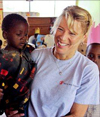 This week, hosts Mark Masselli and Margaret Flinter speak with Carolyn Miles, President and CEO of Save the Children, an independent non-profit organization meeting the basic health, education and nutritional needs of over 140 million children worldwide. Ms. Miles discusses the myriad humanitarian crises the world’s children are currently facing in war zones, refugee camps and infectious disease outbreaks.
Music
Mark Masselli: This is Conversations on Healthcare. I am Mark Masselli.
Margaret Flinter: And I am Margaret Flinter.
Mark Masselli: Well Margaret it’s May already a time for renewal.
Margaret Flinter: Well it’s a time for renewal but also a time for a little celebration so let
rd
us say happy birthday on the 43 anniversary of your founding of the Community Health
st
Center on May 1 , quite a milestone and along with that we do see spring finally arriving
in Connecticut. And that’s a good time to remind our listeners that National Women’s
Health Week is happening in this month and here in our organization we make a
concerted effort to reach out to women in our community with our early detection
programs, prevention programs just making sure wom en get the very best health
services they can to maintain great health. Preventive care such a big part or what
makes good primary care so effective in improving the health of our communities and
out patients.
Mark Masselli: But we have to remember Margaret how difficult it is for women and
children around the world to gain access to healthcare they need especially in areas
around the world where there is unrest poverty and disasters like the one that’s still
unfolding in Nepa l. As days go by the devastation is mounting and the already
challenged healthcare infrastructure is in a great need of global assistance and
(inaudible 01:15). It is going to be a long road to recovery but there are a lot of hands
working very hard to h elp out.
Margaret Flinter: Well that global outpouring of support from millions of people is so
important but we know in times like this we rely on people who have made it their lives
work in the lives work of their organizations and so we thought that this would be a good
time. To read this , a conversation that we had last fall on conversations on healthcare
with Carolyn Miles CEO of Save the Children. That organization is on the ground in the
toughest place of the world to help the most vulnerable am ong those impacted in
disasters like these and that’s the world’s children so we are looking forward to
speaking with Carolyn.
Mark Masselli: We certainly are and they are working in over 100 countries around the
world and I know there are sending delega tions to Nepal as we speak.
Margaret Flinter: Save the Children has a long history of taking their assistance and
taking it right where we can do the most good.
Mark Masselli: We had the folks from doctors without borders on our show with all long
histories of stepping into the toughest places in the world to offer life saving intervention.
Margaret Flinter: But no matter what the topic you can hear all of our shows by going to
chcradio.com.
Mark Masselli: And as always if you have comments please email us at
[email protected] or find us on Facebook or Twitter because we love to hear from
you.
Margaret Flinter: We will revisit out interview with Save the Children CEO Carolyn Miles
in just a moment.
Mark Masselli: But first here is our producer Marianne O’Hare with this week’s headline news.
Music
Marianne O’Hare: I am Marianne O’Hare with these Healthcare Headlines. A lot of
money has been spent on pharmaceuticals according to data recently released by Medicare. $103 billion to be exact and the federal government data showed a mere 14 drugs cost them over a billion dollar each , m ost of the drugs treating common dis eases
among the elderly, hypertension, diabetes, depression, high cholesterol. The mo s t
frequently prescribed drug was Lisinopril as generic used to treat high blood pressure
but Nexium took the top prize. A little purple pill used to treat heart burn, a cid reflux and related systemic elements cost the most but $2.5 billion or $1.5 million at Medicare
patients. Montana has passed a Medicaid expansion bill for the 45,000 people living closer to the poverty line and still uncovered. The bill offers new Me dicaid recipients
help in finding work and getting help with new job skills, education and other benefits.
That provision convinced to republicans to all the legislatures democrats to vote for the bill which the governor signed into law and there is a new tool on the market for tens and millions of families grappling with family members with mental illness or addiction issues. It’s a new book designed for the lay person and created by the American psychiatric association which explains i n laymen’s terms each specific diagnosis, what it
means and how they might better understand the mental illness of dealing with the new resource, understanding mental disorders your guide to DSM - 5 includes in depth
explanations of risk factors, symptoms an d symptom management treatment options
and pathways to success. Former Congressman Patrick Kennedy who struggled with his own mental illness and addiction publicly he said it would have proven a useful tool for his family when he was going through his epi sodes. The guide is available on
Amazon. I am Marianne O’Hare with these Healthcare Headlines.
Music
Mark Masselli: We are speaking today with Carolyn Miles, President and Chief Executive Officer of Save the Children an independent, non - profit, international
organization dedicated t o meeting the needs of over 143 million children in 120
countries including the US. Ms. Miles first joined Save the Children in 1998. Prior to
that Ms. Miles worked as an entrepreneur and liaison for the American Exp ress in Asia
where she first developed an interest in addressing the welfare of the world’s
underserved children. She serves a numerous international boards and the University
of Virginia’s Darden School of Business w here she also were into her MBA. Carolyn
welcome to Conversations on Healthcare.
Carolyn Miles: Thank you Mark.
Mark Masselli: Y ou were in the show a couple of years ago and as an organization that
serves the needs of close to 150 million children around the globe what you see the
big gest threats to childhood well - being? How does your mission at Save the Children
seek to address these challenges?
Carolyn Miles: Well the world hasn’ t gotten us any easier for kids since we last spoke
Mark but Save the Children really works on making s ure that every child has a healthy
start that they have an opportunity to learn and that they are protected from harm so
right there are a lot of difficult things going on whether you are talking about the Ebola
virus in West Africa or kids that are displaced by war in places like Syria and Iraq or kids
right there in the US on our borders that are showing violence from Central America we
are working in all of those areas and in addition to emergencies we also spend a l ot of
our time as you might expect as an organization called Save the Children making sure
that no child dies from something that’s preventive. We also s pend a lot of our time with
moms and newborns to make sure that they particularly survive that really difficult first
couple of months but it has been a really tough summer I have to say in terms of kids.
Margaret Flinter: Well I think we sure that sentiment completely and have too if we
could you reference humanitarian crisis the recent arrival on our boards of thousands of
children flinch striking violence in Central America. Could you give us a bit of an update
on this crisis? Tell us about the condition of the children and maybe a little more for our
li steners little more specifics about what your organization is doing in this crisis?
Carolyn Miles: Sure. I was down in Texas and was looking at the program that Save
the Children already had up and running in Texas and I think there is a couple of thing s
in this crisis that I would focus on. The first one is that the vast majority of these kids
are fleeing some really horrible circumstances in their home country of Honduras, El
Salvador, Guatemala and I sat that with one little boy who was 12 and told m e about
getting beaten up on a very regular basis from older boys who wanted him to join a
gang and the violence that’s happening and that’s these kids are fleeing is really
horrendous and frankly I don’t think of a country we are doing enough to take care of
these children once they do come to our borders we have been able to visit the
detention centers in Texas and New Mexico and frankly the conditions there for children
are not what we all would like to see. We have been trying to do more in the detenti on
centers and not been able to and that’s been really frustrating. Now lost of these kids
left without anything so they are getting clothing, they are getting food, they are getting
some hygiene supplies and those kinds of th ings, able to take a hot shower those are
really important but we have to do a better job at the border and we also have to make
sure that these children get due process because they are in many, many
circumstances. They are fleeing really horrendous cond itions in their coun try and they
need their stories, need to be heard.
Mark Masselli: We know. As parents we would go to know and to make sure as you
said there is no shortages whereas in the world that are impacting children and certainly
you recently were in unless there is a massive intervention under rebuilding the
destroyed infrastructure in Gaza including hospitals and schools and municipal services
like water and sanitation that even bigger humanitarian crisis is looming. How to save
the children , help rebuild infrastructure and what innovative part just can be utilized to
better address the rebuilding of the infrastructure in Gaza and elsewhere.
Carolyn Miles: I was actually in Gaza before fighting broke out just about 2 weeks
before actually a nd it’s a very difficult place in the best of circumstance. It’s very
crowded now much about as destroyed so there is going to have to be a big fund raising
process and a big rebuilding process in Gaza and things like safe drinking water really,
really important for children obviously getting kids back in the school particularly after
such a horrendous emergency that’s always really, really important and Save the
Children has been working in Gaza for about 30 years so we have a lots of experience
there and we will certainly be engaged i n rebuilding there and obviously that war has
killed many, many children and that’s something that is Save the Children we have to
stand up and say something about so we have been doing that.
Margaret Flinter: I am sorry the list is so long of places tha t are really. It’s a tough
summer. The problem is obviously much larger than anyone organization could
address adequately. How is Save the Children partnering with other organizations to
address this crisis?
Carolyn Miles: Yeah so I think one thing to point about Syria and the conflict there
about half of those 1.5 million refugees are children and Save the Children is working
inside Syria and then we are working in the 5 surrounding countries. In all of those
places we work together with both UN agen cies so in a place like Jordan for example
there is a very large refugee camp there. There is about 90,000 refugees there.
UNHCR runs the camp Save the Children and provides the food everyday to the 90,000
and habitants of that camp. We work on pre - scho ol for the younger kids so there is
something for them to do so there is a huge amount of partnership because it’s a huge
crisis. We have never seen a refugee crisis like the scale on scope of what’s happening
in Syria before. You can’t have the children out of school for 3.5 years or they will
probably never go back.
Mark Masselli: We are speaking today with Carolyn Miles , President and Chief
Executive Officer of Save the Children, an independent non - profit international
organization meeting the needs of over 143 million children in 120 countries including
the US and Carolyn the US is also an area focused for save the children and you
recently released a report on Americans readiness to respond to another dis aster on the
shores. It’s been 9 years since hurricane Katrina so tell us about the findings of the
Save the Children disaster report.
Carolyn Miles: We look at these four critical factors in terms of keeping kids safe in
school and child care environments and the good news is that when we started doing
these reports there were four states that met these four criteria. There are now 20
states that meet the criteria. Everyday 69 million children in the United States, we and
their parents then go to either school or the childcare that’s really important that those
facilities are prepared for emergencies. The US is I think third on the list of countries as
the most disaster prone c ountries in the world and we really have to do a better job at
making sure that we are keeping our kids safe.
Margaret Flinter: How are you continuing to promote access to the basic essentials and
health services in these countries they grapple with othe r disasters despite these crisis
that keep rolling over on top of them?
Carolyn Miles: I think Ebola is actually sadly the perfect example of what happens
when you have very weak health system and a big intervention that we do around the
world is we trai n community health workers. They just usually have a basic education
but they can diagnose pneumonia for example which is a huge killer of children all
around the world. They can provide oral rehydration salts to dehydrated children from
diarrhea again a huge killer of children. They can help moms make a plan for their
delivery and we do spend a lot of our time trying to sure up the health systems in these
poor countries.
Mark Masselli: You know sort of going into the internal workings of an organization they
don’t run on just goodwill. 90% of the funds raised for Save the Children go to fund
actual p rograms, such a significant portion of the dollars you raise tell us about the
funding model, how you sustain it and maybe sort of what the projection for the need is?
Margaret Flinter: Yes we do put a lot of focus on accountability and a lot of focus on
measuring where those dollars go and how and more importantly how effective they
were in terms of the programs that we do so we do measure all of our programs in
terms of key indicators, whatever that project is about and what we are trying to do
th
whether it’s ge t kids into school and make sure that they learn and pass through the 5
grade or whether it’s train more health workers and get them into service and
community so a lot of time is spent on attracting of those programs so make sure that
we not only that the dollars have been well spent but that we are learning on what works
the best and we are learning also where things are not working and being able to make
them better so our funding mix is actually one of the things that I think is really terrific
about Save the Children is that we have a philosophy that anyone who cares about kids
can get involved in organization and can certainly figure out a way to help fund the
organization and so we have donors from $10 million donor or kids that bring in their
piggy banks to an individual who gets us $10 million so it’s a very diverse funding
based. We get about 30% of the funding through the US government and then about
70% of it is from corporations, foundations, individuals and everythin g as I said from $10
donation to $10 million donation. Lot of our partners like the Gates foundation for
example pick a particular area that they really are passionate and want to work on and
with Save the Children that area with Gates is newborn survival and so have been
working with them for 10 years and we are in that for the long - term and are really trying
to drive the down numbers of kids that die in that first month which is the biggest part of
kids that die under the age of 5 so the needs frankly ar e always far out strip the
resources that you have so I certainly spend time fund raising and we have a group of
people that’s really what their job is all about and as again what I think is great about
Save the Children is that there is a place for everyb ody to help in our organization .
Margaret Flinter: Carolyn you blogged earlier this year about your meetings with the
Clinton Global Foundation at United Nations and you suggested that there is still too
much talk about what needs to be done to address the global needs of children and
maybe there ought to be more shouting about the need to confront preventable causes
of death and disease in children around the globe. What is the po licy initiatives that you
are advocating more strongly for?
Carolyn Miles: I think there is a couple of things on our agenda. One is Syria which we
talked about earlier which I think is typically what these kind of very long drawn out Civil
War type of situations like Syria people do tend to forget and they tend to think there
really isn’t anything that we can do anymore about Syria and both for people that are
still inside Syria and also for the refugees that are outside and whether that’s providing
school or continuing to make sure that these families have a roof over their head and
they still need help and so we will be certainly pushing on Syria and the other piece I
also menti oned was on newborns and I think most successful things that the world has
done is around child survival and if you look at the number of kids that die every year of
things that we can prevent that number has almost gone down by 50% since 1990 and
that’s q uite a dramatic drop but again newborns are still the biggest part of that number
and there are 6.6 million kids every year that die of things that we can prevent and in
many countries that, that 50% of that number is kids in that first month of life so wh at
can we do around newborns. We have been pushing with various countries to put
together something called the every newborn action plan so they actually have put
together a plan in Ethiopia that says here is the things we have to do for newborns in
our c ountry and here is what the Ministry of Health is committing to do and so almost
every country now it certainly the ones that are critical in terms of child survival have put
together those plans and so we will be spending time at the UN General Assembly
when the leaders of these countries are in town to really push that piece as well so
tho se are just two of the things we will be talking about .
Mark Masselli: We have been today with Carolyn Miles President and Chief Executive
Officer of Save the Childre n, independent, non - profit international organization meeting
the needs of over 143 million children in 120 countr ies including the United States. You
can learn more about their work by going to savethechildren.org. You can follow her on
her blog loginmi les and/or twitter@carolynsave. Carolyn thank you so much for joining
us on conversations.
Carolyn Miles: Thank you.
Music
Mark Masselli: At Conversations on Healthcare we want our audience to be truly in the
know when it comes to the facts about Healthcare Reform and Policy. Lori Robertson is
an award winning Journalist and Managing Editor of factcheck.Org a non - partisan, non -
profit consumer advocate for voters that aim to reduce the level of deception in US
politics. Lori what have you got for us this week?
Lori Robertson: Well listeners may wonder how effective fact checking in journalism
can be, especially considering that politicians repeat many false and misleading claims
over and over again. We have long said that our job at factcheck.or g isn’t to change
politicians behavior rather our focus is on our main voters with accurate information and
two new studies show that fact checking can indeed lead to a better informed public.
The American president institutes fact checking project publis hed growth study one by a
political scientist that Columbia University found that even though false claims on
Twitter hugely outnumber attempts to correct them fact checkers do appear to help
Twitter debate become more accurate over time for instance the s tudy analyzed tweets
about a false claim that 2 million Americans when lose their job because of Obama
care. As we reported before the non - partisan Congressional Budget office said that two
million people would decide to not to work such as retiring earli er were to work less
because of the law not that they wouldn’t lose their jobs. But the Columbia study found
that tweets endorsing the false claim outnumbered those attempting to correct it by a
ratio of 13:1 in the first three months of 2014. Still the study found the relative share of
corrective tweets increased as these types of social media frenzies started to frizzle.
Another study by Professor George Washington University found tha t many Americans
not only believe things that aren’t true but are very confident that their false notions are
correct but the study the tested whether a fact checking could correct mistaken beliefs if
found encouraging results. About a month after the ini tial survey the study gave the
correct information once and briefly to those who had held mistaken beliefs. It’s found a
significant decrease in misperception in those who were told the correct information. So
there is some support to show that fact chec king can indeed set the record straight. I
am Lori Robertson, Managing Editor of factcheck.org.
Music
Margaret Flinter: FactCheck.org is committed to factual accuracy from the country’s
major political players and is a project of the Anna Bird Public Policy Center at the
University of Pennsylvania. If you have a fact that you would like checked Email us at
CHCradio.com. We will have FactCheck.org Lori Robertson check it out for you here on
Conversations on Healthcare.
Music
Mark Masselli: Each week conversations highlight a bright idea about how to make
wellness a part of our communities in everyday lives. Lea n ne Brown was a graduate
student in Nutritional Science at NYU. She came to understand the enormous
challenges of eating healthy fo ods or doing field work with some of New York City’s
more impoverish populations and when it came time to do her thesis she thought why
not write a cookbook of health recipes aimed at a millions of Americans living on food
stamps or snap stipends of $4.
L e a n ne Brown: $4 a day is sort of a general rule of thumb for around how much a
person truly is qualifying for food stamps would have to eat per day so we felt like that
was a more useful explanation so we explained like a burgeon range or sort of like a
w ay of saying this is a snap cookbook without actually saying getting so many words.
Mark Masselli: She learned that well poverty was a serious issue and the lack of
access to nutritious food was also contributing to obesity and poor health in many of
the se families so she conducted extensive research on shopping and health cooking
techniques and crafted good and cheap. A cook book aimed at not only teaching these
families how to shop for affordable produce and healthy foods but how to get an entire
family to cook in a more healthy way.
Leanne Brown: I really wanted to arm people with the ability to walk into a grocery store
and say like okay this how I sale. I can totally make something too much as that type. I
know how to do that and that’s not the ea siest thing to be able to do. For a lot of people
you go this is the recipe I have. This is another ingredients that better go and carefully
shopped for each of those but that doesn’t allow you to sort of find the deals and find
the value in order to get by on such a small amount of money. You need to be able to
be adaptable.
Mark Masselli: His thesis was so well received. She launched a kick starter campaign
to raise enough money to make the book available at soup kitchens, women shelters
and communi ty health centers and for every copy she sells she gives one free copy to a
school, a health center or an organization requested.
Leanne Brown: We can’t give these books away completely free but the idea is that this
is a cookbook that needs to be put in the pants or someone who really can afford the
cookbook. So that’s what the idea of doing a buy one, get one like (inaudible 24:08)
came from. There are people out there who are really excited about (inaudible 24:12)
and have money to spend on it and wh o can appreciate that if they can sort of help to
subsidize those who can’t.
Mark Masselli: She has made her book available as a free PDF download to anyone
who wants it. Good and cheap a cookbook aimed at the food stamp population or
anyone else on fix ed income for that matter. Helping to positively influence their diets,
obesity and well - being now that’s a bright idea.
Music
Margaret Flinter: This is Conversations on Healthcare. I am Margaret Flinter.
Mark Masselli: And I am Mark Masselli. Peac e and Health.
Conversations on Healthcare broadcast from the Campus of WESU at Wesleyan
University.
Streaming live at wesufm.org and brought to you by the community health center.