Dr. Victor Dzau, President of the National Academy of Medicine

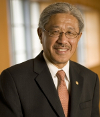 This week, hosts Mark Masselli and Margaret Flinter speak with Dr. Victor Dzau, President of the National Academy of Medicine (the former Institute of Medicine) a private, non-profit entity dedicated to tackling the nation’s complex problems in medicine, technology and science. Dr. Dzau talks about the Academy’s shift towards more cooperation between the scientific disciplines to advance evidence-based research that will inform the health care providers and policy makers around the country and the world.
Dr. Victor Dzau – President of the National Academy of Medicine
(Music)
Mark Masselli: This is Conversations on Health Care. I am Mark Masselli.
Margaret Flinter: And I am Margaret Flinter.
Mark Masselli: Well Margaret, It’s the senate’s turn now the leadership in the
senate is working to create their own versio n of a bill to replace Obamacare . A
team of 13 republic and senators are attempting to rewrite a bill that dovetails off
of the American Healthcare Act which passed in the house by a very slim margin
before the congressional budget office had a chance to rate the bill and there is
the rub Margaret.
Margaret Flinter: Well the CPO report which came out after the house approved
the health re form measure predicted that the ACHA would lead to 23 million
Americans losing health insurance coverage and that the ACHA would
significantly increase premiums for older and sicker Americans.
Mark Masselli: Senate majority leader Mitch Mc C onnell has already hinted that
there may not be a bill that could win the support of 50 GOP senators at the
moment. There were sena tors in the GOP like S enator Susan Collins of Maine,
and S enator Lisa Murkowski of Alaska who say they will not support a bill that
eliminates coverage for so many Americans . T he process is being carried out in
relative secrecy.
Margaret Flinter: Well M ark what we do know in the President’s Budget is that it
signals significant cuts across the healthcare spectrum. In addition to the $800
billion being cut from Medicaid by the GOP health reform measure, President
Trump has proposed a significant cut to M edicaid on top of that which could lead
to an estimated $1.7 t rillion reduction in funding over 10 years that is just a
devastating blow to healthcare for tens of m illions of Americans.
Mark Masselli: There is another area that is facing serious cuts und er the
President’s budget , t he President’s proposed funding of the National Institute of
Health cuts it by 22% and it ’ s something that very much concerns our guest
today.
Margaret Flinter: Dr. Victor Dzau is the President of the esteemed National
Academy of Medicine , a Division of the National Academy of Science, whose
collective goal is to advance research that supports evidence based practices in
medicine as well as in scientific research and with that in mind we though t this
will be a good time to revi sit our conversation with Dr. Dzau.
Mark Masselli: And Lori Robertson also stops by, the Managing Editor of
FactCheck.org. But no matter what the topic, you can hear all of our shows by
going to www.chcradio.com .
Dr. Victor Dzau – President of the National Academy of Medicine
Margaret Flinter: And as always, if you have comments, please e - mail us at
[email protected] , or find us on Facebook or Twitter because we love to hear
from you. Now we will get to our interview with Dr. Victor Dzau in just a moment.
Mark Masselli: But first, here is our producer Marianne O’Hare with this week’s
Headline News.
(Music)
Marianne O’Hare: I am Marianne O’Hare with these Health Care Headlines.
They are working behind closed doors on a revised v ersion of the American
Healthcare Act . Policy w onks are hard at working Washington making alterations
to the healthcare bill composed by House Speaker Paul Ryan which passed
narrowly in the House. The Senate has a tricky road to navigate after the house
passed their version of the AHCA , the nonpartisan CBO report came out. The
congressional budget office revealing the dark underbelly of the bill namely 23
m illion Americans loosing coverage under the GOP plan and it was certainly the
higher premiums for t hose older folks who would no longer maintain Federal
Protections from Insurance premium gauging for preexisting conditions and as
recipient ’ s age passed the age of 50 their rates will go up exponentially as well.
Senate leader Mitch Mc C onnell has said pu blicly that at the moment it doesn’t
look like they have the necessary votes among the Republican majority to pass
the bill that they are currently drafting whose details are still rather murky.
Meanwhile drug makers have been lobbying Congress e specially the Senate
hard on health reform while President Trump has said he vows to clamp down on
drug prices. So far there has been no legislation in that direction pharmaceutical
industry has spent roughly $80 m illion in the first quarter alone in lobbying fees .
As whether worms the CDC warns brace yourself for more Zika , the Zika virus
made relatively little impact in the continental US all though Florida was hard hit
and then all the re were about 5 , 000 cases of Zika infection reported in the U.S
doing about 6 5 babies were born in the U.S . to Zika infected parents and
suffered some birth defects . The at U . S . territory of Puerto Rico so about 35 , 000
cases and a much higher number of affected offspring Zika poses the greatest
threat to developing fetuses. The C DC warns they simply don’t know enough
about this year’s Zika threat and warned that emergency plans should be put in
place ahead of further outbreaks. Me anwhile the recently released to White
House budget proposes establishing an emergency fund to financ e responses to
outbreaks like Zika but it also slashes $838 m illion from the National Institute of
Allergy and Infectious Diseases , t he agency behind vaccine development . S o far
there has been little talk from Congress on approving extra funding. An HPV is
gaining an edge , cancers related to the human papillomavirus have spiked in
recent years with more than 3 0, 000 cancers per year being attributed to the
sexually transmitted virus , rates of HPV vaccination however have fallen off.
I am Marianne O’Hare w ith these Health c are Headlines.
Dr. Victor Dzau – President of the National Academy of Medicine
(Music)
Mark Masselli: We are speaking today with Dr. Victor Dzau, President of the
National Academy of Medicine, formerly the Institute of Medicine , a private
nonprofit institution providing objective analys i s and policy advice to solve the
nation’s complex problems related to science, technology and medicine. Dr.
Dzau, most recently served as Chancellor for Health Affairs at Duke University,
and President and CEO of Duke University Medical Center. Prior to that, he was
Chairman of Harvard’s Medical School Brigham and Women’s Hospital and also
served as Chairman of the Department of Medicine at Stanford University. Dr.
Dzau is a renowned researcher whose work lead to the development of ACE
Inhibitors now used widely for treatment of high blood pressure. Dr. Dzau earned
his medical degree from McGill University Medical School in Montreal. Dr. Dzau,
welcome to Conversations on Health c are.
Dr. Victor Dzau: It's a great pleasure to be talking to you.
Mark Masselli: You r appointment at the National Academy of Medicine came at
a very interesting in flection point in healthcare, your background in translational
science speaks to the emerging reality of modern healthcare which increasingly
is becoming an interdisciplinary pa rtnership and I am wondering, if you could tell
our listeners how that background is shaping the direction that you are leading
the academy through during this time of transformation in healthcare.
Dr. Victor Dzau: Well Mark, I would say there is never a more exciting but
challenging time in science, medicine and healthcare. If you look at advances in
science and technology they are breathtaking. Genome sequencing for $1,000,
precision medicines, stem cell, regenerate medicine, gene editing, and yet the
world is facing unprecedented challenges in say increased disease burden such
as obesity, diabetes, the emerging infections like Zika and Ebola, and of course,
our healthcare system is fragmented and really too expensive. The National
Academy of Medicine has been around for about 50 years, and we have found
our roots in the National Academy of Science which was chartered by Abraham
Lincoln and Congress to be independent advisors to the nation. We must
continue to be that evidence - based trusted advisor an d independent from politics
or any kind of non - science believes. And so we have asked ourselves to be
more innovative, more action - oriented and we have recently redone our mission
statement to say our job is to improve health for all and to accelerate pro gress in
science, medicine and policy, but address health equity issues. That’s what I
hope to bring to National Academy of Medicine.
Margaret Flinter: I look back at the work that you have done, you have served at
the home at the number of the nation’s premier medical institutions most recently
were Duke before that Harvard and Stanford, and you oversaw just a
tremendous amount of transformation at Duke launching both the Global Health
Dr. Victor Dzau – President of the National Academy of Medicine
and the Translational Science Institute. What did you learn acceler ating change
at the academic level that’s going to inform the work being undertaken at the
National Academy of Medicine?
Dr. Victor Dzau: What I have learned in my journey is of course it's really
important to take a step back and ask ourselves what exac tly are we trying to
accomplish, what are we all about, and it is about doing good for society. The
recent re organization of the national academies we are the National Academies
of Sciences, Engineering and Medicine, three academies under the same roof.
It's about collaborating across disciplines and creating a culture that really forces
innovation and evidence - based so that people can trust us that what we say are
based on facts and the very best minds.
Mark Masselli: Well, you mentioned earlier a conc ern about the partisanship
st
that’s been happening. I think we are all booed by the passage of the 21
Century Cures Act. As you contemplate the new administration, I am wondering
if you have any thoughts about their commitment to the advancement of
biome dical research.
Dr. Victor Dzau: I am cautious but optimistic. We anticipated of course a change
in U.S . administration, and so we started this initiative called Vital Directions for
Health and Health Care. Dr. Mark McClellan Co - Chaired this with me as you
know he was the previous FDA Commissioner and CMS Director, he is a
Republican, and two of us put together a steering committee of really notable
individuals who understand health, but also understand policy and government.
We have people like Mike L eavitt and Tom Daschle really in many ways I would
say nonpartisan, not even bipartisan.
Margaret Flinter: Right.
Dr. Victor Dzau: And so we worked on policies and actions that can yield timely
and measurable progress, and we have three key goals bette r health and well -
being, high value health care, and strong science and technology. We brought
together 150 experts to guide us and we had a big summit . A nd right now, we
are synthesizing all these pieces together so that we can give to the
administratio n seven very clear priorities that they need to consider going
forward. And so I do think there is a real opportunity to work together with the
new administration to look at what’s ahead of us and what we must to do
together to improve health of the natio n.
Margaret Flinter: I know Dr. Dzau that you also have a very significant focus on
global health, and you warn that global pandemics could cross the global
economy some $6 trillion. What does the National Academy of Medicine
recommend as the more sound approach to meeting these global pandemics?
Dr. Victor Dzau – President of the National Academy of Medicine
Dr. Victor Dzau: You know , what happens in a far corner of the world can rapidly
affect us , you know , be a pandemics, law, security, refugees, climate change,
and we have to lead , everything is hyper connected , health influences , economy
influences national and global security. I think that the decision makers who
understand that if we stand on sideline we don’t invest enough in health we may
end up with negative impact on the economy and the security. Take f or example,
Ebola during the outbreak, borders were closed, people stop ped traveling, lives
were lost and the impact was huge and our report when we assess the loss per
year by pandemics in the world is $60 billion. So the trillion numbers to say if you
i magine this for a century , but I think security is the other issue. Think about the
security issue in terms of borders and people moving one to the other, and think
about the world now which these pathogens can be used as weapons. That
report basically h ighlight the importance of health in a connective fashion and
everything else. We put that much money to Homeland Security, into military,
and to Cybersecurity we got to put money into health security.
Mark Masselli: We are speaking today with Dr. Victo r Dzau, President of the
National Academy and Medicine. Dr. Dzau, as I hear you speak about the work
and the mission of the National Academy of Medicine you are standing on the
shoulders of so many tireless dedicated volunteers. One of the memorable
repo rts was your 1999 Report ‘To Err is Human’ which shined a spotlight on one
of the medicines most concerning short comings the high rated deaths related to
medical errors. And it's now been 17 years since that initial report, and the
numbers still remain un acceptably high, and I wonder if you could talk to our
listeners about the works that’s been done and chart some of the strategies that
you have going forward.
Dr. Victor Dzau: We have some 2,000 academy members who are being elected
every year leading s cholars and experts in health and science and medicine I
think we have something like 15 noble laureates . S o that we have the best
minds in engineering and economy, etc. So this r eport ‘To Err is Human’ is an
example of the contribution that we can make 17 years ago I remember this
report that says , you know , up to 90,000 U . S . citizens can die from preventable
deaths in the hospital and it's from errors and that was a wakeup call. In the last
17 years, the world has gone on the journey on understanding h ow important it is
to say quality is important, safety is important. If we have a system and a culture
of patient first quality of care, safety of care and that system should greatly
reduce the error that you could make inadvertently as you know I was at Duke
and we have some infamous cases of patient safety problems , we learn huge
amount, we have to have a culture where people say if I see something that’s not
right, I can speak up and the re will be no retribution. I will say the impact is
enormous , you know , from almost like dark ages to where we are today using
now of course technological tools to report, to track and we are able to collect
much better numbers than we collected 17 years ago. I am sure you follow that
arc 2016 we plotted the data showin g that some of the changes they put in place
Dr. Victor Dzau – President of the National Academy of Medicine
particularly in terms of measuring hospital performance, have greatly reduced
errors and save lives and save money.
Margaret Flinter: Well Dr. Dzau, another area where we admire and follow the
National Academy of Medicine is in its commitment to fostering workforce
development so as , you know , the academy released a l au ded groundbreaking
report at the future of nursing several years ago and they followed up with the
report just about a year ago I think looking at progress on those
recommendations. Can you address that initiative and how the National
Academy of Medicine is working to advance that cause?
Dr. Victor Dzau: When I was at Duke, I was responsible for the nursing school
as well and the medical school and the hospitals, and I see this entirely of
nursing in frontline but also in education and research. It is the most downloaded
report ever.
Margaret Flinter: That’s right.
Dr. Victor Dzau: And I think what this report really said was we have to hav e
nurses practice to full extent of their education training and not the old days
where they are just to serve the doctors. Particularly when you think about what
they do and how compassionate and capable they are and the fact that we have
shortage of phy sicians nurses should lead, should practice to full exten t of
education. The report says they should have high level s of education because
the evidence show the more educated nurses are the better the patient outcome,
their goal is to say how many must ob tain their b achelor degree, how many
should get higher education doctor of nurse practice and PhDs, etc . and the
report says they should be full partners with physicians and other health care
providers and they should become involve d with effective workfor ce planning.
Sure ly have to release report RWJ launched this ‘Future Of Nursing Campaign
For Action’ which is say how do you implement all those recommendations. So
we have certainly seen changes in states that remove major barriers and giving
full pract ice authority to nurse practitioners. But let me say that it's not just
nursing, it's inter - professional education. That there is a recognition that we work
around the patient and the team supporting the patient, doctors, nurses but also
social workers, pharmacists. Certainly when I was at Duke we push for what we
call inter - professional education, getting people from different profession al work
together early doing their training to learn to work as a team working for the same
purpose which is improved care for the patients.
Mark Masselli: Dr. Dzau, you were saying that we want to contribute to the
health of our people and globally, and I was thinking about the work that’s
happening over the NIH with their Precision Medicine Initiative this million liv es
st
study that the President has been behind certainly the 21 Century Cures Bill is
adding some money to it. Thoughts about genomics that sort of intersection of
medicine science and personalized health many of the ways they have tried to
Dr. Victor Dzau – President of the National Academy of Medicine
put this togeth er i s this sort of an interdisciplinary approach trying to bring
everybody to the table. Some thoughts about that?
Dr. Victor Dzau: Right.
Mark Masselli: Some thoughts about that?
Dr. Victor Dzau: And more than that they bring patients to the tabl e.
Mark Masselli: That’s right, yes.
Dr. Victor Dzau: Yeah right. It's a big voluntary program where we want people
to volunteer being willing to share their DNA information, being willing to see that
this is collectively where we can learn from engag ing the patient population so a
big part of this is in fact engaging patients. You know I think this Precision
Medicine Initiative is one of the signature initiatives of President Obama. I
certainly feel that he has been a great support of science and he alth, look at
some of the initiatives he has taken on in brain, precision medicine and many
other areas. As you all know the promise of precision medicine is that we will be
able to develop the tools that can precisely identify the appropriate vulnerable
individuals and very early intervene if not find specific treatment. Sequencing
human genome is only one part of information you got to get lot of other
information to link them together that includes all the [inaudible 00:19:08 ]
Technology, biomarkers bu t also the data that you can collect from electronic
health record, from the wearables, biosciences from Big Data and because of
these huge amount of scientific and clinical information, there is a long way to go
to be able to collect them, to coordinate t hem, being able to analyze them, and to
make useful information out of them. But importantly, we have to address of
course patient privacy, we have to understand security of the data. So this
initiative is really moving the whole nation forward for the f uture and I am very
excited about this .
Margaret Flinter: We have been speaking today with Dr. Victor Dzau, President
of the National Academy of Medicine and the National Academy of Sciences.
You can learn more about their work by going to www.nam.edu . Dr. Dzau, thank
you so much for joining us on Conversations on Health c are today.
Dr. Victor Dzau: What a great pleasure. Thank you very much.
(Music)
Mark Masselli: At Conversations on Health c are, we want our audi ence to be
truly in the know when it comes to the facts about healthcare reform and policy.
Lori Robertson is an award - winning journalist and managing editor of
FactCheck.org, a nonpartisan, nonprofit consumer advocate for voters that aim to
Dr. Victor Dzau – President of the National Academy of Medicine
reduce the le vel of deception in U . S . politics. Lori, what have you got for us this
week?
Lori Robertson: Health and Human Services Secretary , Tom Price , made two
claims about opioid addiction that are contradicted by the National Institute on
Drug Abuse which is pa rt of the Department Price had. Price said , “ F olks need
to be cured so they can be productive members of the society , but there is
currently no cure for addiction to opioid s or any other drug.” The National
Institute on Drug Abuse says , “ A ddiction is tre atable and can be successfully
managed.” According to experts , substance use disorder can be successfully
treated but it can’t be charred . Speaking about treatment, Price claimed , “ If we
are just substituting one opioid for another, we are not moving the dial much.”
But using opioid s to combat addiction to more dangerous opioids including h eroin
is effective say experts in the National Institute on Drug Abuse. While there is no
cure for opioid addiction, medication assist ed a treatment “ save lives” help to
stabilize individuals allowing treatment of their medical, psychological and other
problems , so they can contribute affectively as members of families in our
society. One expert told us that the science is clear , w ith medications, addicts
have at leas t double the chance of becoming opioid free. Nationally , the rate of
opioid related deaths increase d from around 3 per 1 00, 000 people in 2000 to
more than 10 per 1 00, 000 people in 2015 , over a 3 3, 000 people died of opioid
related overdoses in 2015 alone. This includes not elicit opioid s such as heroin
and prescription opioid s including oxycodone and hydrocodone. Price’s
spokesperson said that he supported “ expanding access to treatment and
recovery services including medication assisted treatment. ” And that’s my fact
check for this week. I'm Lori Robertson, Managing Editor of FactCheck.org.
Margaret Flinter: FactCheck.org is committed to factual accuracy from the
country's major political players and is a project of the Annenberg Public Policy
Center at the University of Pennsylvania. If you have a fact that you would like
checked, email us at www.chcradio.com . We will have FactCheck.org's Lori
Robertson check it out for you here on Conversations on Health c are .
(Music)
Margaret Flinter: Each week Conversations highlights a bright idea about how to
make wellness a part of our communities and everyday lives. Diabetes is a
chronic illness for which behavioral choices such as diet and exercise are
extremely imp ortant. But in c entivi z ing behavior change and large patient
populations is very challenging. A recent study done by Emory University and
the nonprofit organization focused on improving the health of India’s population
of a billion people found that text m essages sent through smartphones might be
a powerful tool in promoting diabetes prevention behaviors. They partnered with
India’s leading provider of mobile phones Nokia to harness a research cohort of a
million clients receive diabetes prevention text me ssages.
Dr. Victor Dzau – President of the National Academy of Medicine
Nalini Saligram: So the text messages themselves were developed with Emory
University’s Rollins School of Public Health because we wanted them based on
science and behavior change theory.
Margaret Flinter: Nalini Saligram, CEO of the Arogya Fou ndation , t he text
messaging study was designed to generate improved activity around four simple
goals, consume more fruits and vegetables, avoid fried foods, and exercise
regularly.
Nalini Saligram: The sequence of the messages and how frequently they we re
texted was all based on behavior change theory as well as on Nokia’s experience
from their consumer base.
Margaret Flinter: Participants received just two text messages per week showed
an average 40% more compliance with those activities than those wh o did not
receive the messages. A low - cost targeted text messaging system sent directly
to consumers reminding them of the power they have to maintain simple lifestyle
changes that can improve their chances of preventing or better managing
diabetes and ot her chronic illnesses, now that’s a bright idea.
(Music)
Margaret Flinter: This is Conversations on Health c are. I am Margaret Flinter.
Mark Masselli: And I'm Mark Masselli, peace and health.
Conversations on Health c are, broadcast from the campus of WESU at Wesleyan
University, streaming live at www.wesufm.org and brought to you by the
Community Health Center.