Save the Children CEO Carolyn Miles Examines Threats to Children in “End of Childhood” Report

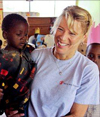 This week, hosts Mark Masselli and Margaret Flinter speak with Carolyn Miles, CEO of Save the Children, on the plight of children in the US and around the world. She discusses their new report on the “End of Childhood” and the ongoing threat to child wellbeing due to war, the refugee crisis, and lack of access to education and other opportunities due to growing global disparities.
Carolyn Miles, CEO of Save the Children
Mark Masselli: This is Conversation on Healthcare, I am Mark Masselli.
Margaret Flinter: And I am Margaret Flinter.
Mark Masselli: Well, Margaret, the Senate is delaying a vote on its version of the
bill to repeal and replace the Affordable Care Act. When it became clear that a
th
vote before the July 4 recess would come up short of the necessary votes,
Senate majority leader Mitch McConnell called for a delay. The nonpartisan
Congressional Budget Office released a rather scathing score of the Senate
Republican Health Bill predicting significant cuts to coverage for millions of
Americans. The CBO says that the Senate Health Bill will lead to 22 million
Americans losing health coverage.
Margaret Flinter: Well, let’s just say that would be a devastati ng blow to the
million of Americans, who receive care through Medicaid, whether it is the
disabled, other vulnerable populations including, Mark, and I think people don’t
realize this, 40% of the nation’s children and that could seriously undermine
access to quality care for so many people and have a profound influence on
health outcomes.
Mark Masselli: Well, the Senate Bill has been described as a shift of wealth from
the poor to the rich offering significant tax cuts to the insurance industry, as well
a s to other stakeholders.
Margaret Flinter: And the nonpartisan CBO scored the House Bill very negatively
saying it would lead to the loss of health coverage for at least 23 million
Americans and would raise costs significantly for health consumers, but n o
matter what the score, you just have to see the reality. It is bound to cause harm
to many of the nation’s most vulnerable residents including children.
Mark Masselli: And that brings us to today’s guest, Margaret. Every few years
we would like to ch eck in with Carolyn Miles, CEO of Save the Children. They’ve
just released a new report on the status of children worldwide and the conclusion
is that a quarter of the world’s children are being denied a childhood.
Margaret Flinter: We look forward to c atching up with Carolyn Miles and hearing
about their important work in this new report.
Mark Masselli: And Lori Robertson stops by. She is the Managing Editor of
FactCheck.org, who looks at misstatement about health policy in the public
domain, but no matter what the topic, you can hear all of our shows by going to
www.chcradio.com .
Margaret Flinter: A nd as always if you have comments, please email us at
www.chcradio@c hc1.com or find us on Facebook or Twitter , because we love to
hear from you. We’ll get you our interview with Carolyn Miles in just a moment.
Carolyn Miles, CEO of Save the Children
Mark Masselli: But first, here is our producer Marianne O’Hare with this week’s
Headline News.
Marianne O’Har e: I am Marianne O’Hare with these Healthcare Headlines. They
are going for the delay. Senate majority leader Mitch McConnell had been
gunning for an early vote on the GOP controlled Senate’s Healthcare Bill and had
th
wanted to vote on that Bill before th e start of the July 4 recess, but there a
significant opposition, Senate Republicans released their secretly crafted answer
to the House’s American Healthcare Act and for all intention and purposes, the
Senate version is quite similar; elimination of Med icaid expansion, elimination of
the individual mandate require Americans to buy insurance and a chance for
State’s to apply for waivers that would allow them to cover less and charge more
for those with preexisting conditions. According to the CBO, 22 mil lion
Americans would end coverage or lose it within 10 years. The insurance
companies will be allowed to charge older, sicker Americans high er premiums,
five times as much. The Senate needs 51 votes to pass the Bill, which could get
done with 50 Republic an Senators and Vice President Mike Pence lending a
deciding vote, but the number of Republican Senators, who they say they won’t
vote for the measure grew to at least five including Senators like Susan Collins of
Maine, who says the Bill would harm the on e in five residents of her State who
rely on Medicaid and Senators such as Rand Paul, who called the Bill
ObamaCare - Lite, saying at least too many restrictions in place. Meanwhile a
bipartisan coalition the nation’s Governors are expressing extreme disple asure
with the Bill, which they say will harm State Government significantly. Ohio
Republican Governor John Kasich is leading the coalition, which includes
Nevada’s Republican Governor Sandoval and Colorado Governor Hickenlooper,
a Democrat, all pointing to Medicaid cutbacks, specifically as a threat to not just
to health of their residents, but to the stability of the health industry and State
budgets as well. Senators are planning on holding town halls at various locations
th
around the country during the July 4 recess including Louisiana Senator Bill
Cassidy, a Republican and physician, who is uncertain he can support a Bill that
harms so many that rely on the safety net. A year after it was first launched,
participants of former President Obama’s Cance r Moonshot initiative led by
former Vice President Joe Biden, met again in Washington to discuss their goals
for curing cancer. The Cancer Moonshot one year later summit renewed
commitment to collaborating on better data sharing for faster cures, but also
committing to keep up pressure on the current powers that begin in Washington
in the wake of significant cuts to science and research budgets under President
Trump. And wave of the future for infertility, scientists have used a 3D printer to
create a mou se ovary capable of producing healthy offspring and in the mice, the
result was a structure of about the size of a pea recreating the environment
inside natural ovaries. Next, researchers placed real tissue for mouse ovaries
known as follicles into the 3D printed ovary scaffolds. The researchers
transplanted the devices into sterilized mice, blood vessels attached themselves
to partially artificial ovaries, which then began to function. Researchers hope to
Carolyn Miles, CEO of Save the Children
create replacement human ovaries someday in the future. I am Marianne O’Hare
with these Healthcare Headlines.
Mark Masselli: Prior to becoming CEO, Ms. Miles served as Chief Operating
Officer at Save the Children. She spent her earlier career working as an
entrepreneur, as well as for American Expre ss in Hong Kong, where her attention
shifted to improving childhood welfare. Ms. Miles has served on numerous
boards including the University of Virginia’s Darden’s School of Business, where
she received her MBA. She was named one of the 50 of the world’ s greatest
leaders by Fortune Magazine; Carolyn, welcome back to Conversations on
Healthcare.
Carolyn Miles : Thanks so much Mark and Margaret , it is great to be back with
you both.
Mark Masselli: Yeah, and it has been a few years since we caught up on the
refugee crisis and at that point, you were telling us about just the incredible
dislocation that was happening to millions of children around the world and really
it does not seem like it has gotten better in that last check, a record number,
more than 65 million people in the world are now living as displaced refugees
around the world and half of them are children, but I am wondering if you could
bring our listeners up to date on the status of the refugee crisis and its continued
impact on children’s l ives.
Carolyn Miles : I wish I could say that things have gotten a lot better since the
last time we spoke, but as you said, they haven’t and so there are massive
numbers of children that have been affected and Save the Children has been
working on this c risis really for six years now, but I also think it is really important
to put a face to this crisis and I have been spending much of my time traveling to
visit the refugee crisis again and you know, I met a young girl in Lebanon, for
example, who was in s chool for the first time in three years since she had last
been in her hometown of Aleppo, so one of the things that we are finding is that
the mental trauma is really starting to show up in kids, many more instances of
self harm and bedwetting and nightma res and those kinds of things and that’s
really showing up now in a bigger way and if you think about it, it is
understandable because these kids have been under stress for so long, so we
continue to try to provide those safe places for children, the outle ts for them to
have some normalcy that is super important I think for these children.
Margaret Flinter: Well, Carolyn, Save the Children has just released an in depth
analysis of the plight of the world’s children. The inaugural end of childhood
report, that’s a chilling title right there. 700 million children, roughly a quarter of
the world’s child population really being denied the experience of being a child, of
childhood; really, these children are found everywhere being impacted by a
variety of cha llenges, from war to displacement, poverty, and lack of access to
basic resources. Tell us what some of the most troubling impacts on childhood
Carolyn Miles, CEO of Save the Children
on these children are that you found and their likely long - term effects in terms of
stress and really almost a posttraumatic stress syndrome, but please share with
us what you found.
Carolyn Miles : I think we can all relate to childhood as a time that should be, you
know, a time to learn, to play, but unfortunately, this report showed us that one in
four children , for them their childhood is ending too soon and so that’s why we
launched this report. It was really to raise the fact that this is happening for so
many kids around the world. So we looked at actually, eight, what we call
childhood enders, things like child mortality, so children being killed before their
th
18 birthday, malnutrition, which stunts children not just physically, but it stunts
their growth mentally, being out of school, so having an end to their education,
child labor, really a child going to work at a very young age, child marriage, which
we know for girls, particularly is a huge ender of childhood, being a victim of
extreme violence and I was in Latin America, where I saw this, earlier this year,
and then forced displacement by conflict, so being a refugee or being displaced
inside your country. Those are the things that really we believe end childhood
and we looked across 172 countries, and we ranked countries in terms of their
ranking on those eight indicators, but one of the things tha t we found is that when
we examined these childhood enders, refugees and the inability to live in your
home is one of those enders and that really is driving kids out of school, it is
causing early marriage actually for a lot of the girls, so you know we a re still
seeing things like malnutrition being huge problems. So you will see that you
know children are physically smaller, shorter, and lighter, but what you don’t see
from the physical side is what happens to kids’ brains and we know that nutrition
is so critical, particularly in those early years.
Mark Masselli: You know, Carolyn, I imagine as you start to deal with so many
different individuals, and so many different cultures and more ways that they
raise all sorts of different problems for youth, c hild marriage in particular and it
still seems to be culturally accepted in many societies and one girl under 15 is
forced to marry every 7 seconds around the world, and I am wondering again if
you could share with our listeners, the long - term impact on ch ildhood marriage.
Carolyn Miles : And as you said, Mark, there are 40 million girls aged 15 to 19
currently, who are married at those ages, so girls who are married as children,
they are much more likely to drop out of school. Most of them will drop out of
school. They will then usually have a child within a very short time of being
married. When they are marrying at the age of 13 or 14, they will have children
and at 15 or 16 and kids having kids is very dangerous, not only for the mother,
but it is al so quite dangerous for the baby, so you have higher rates of child
deaths, prenatal issues for the mother, and then it is more likely for this whole
cycle to repeat. Those children don’t get an opportunity to go to school, so you
know one of the best thin gs to protect children is to really move that age of
marriage up for girls. I was just in Greece about two weeks ago and visiting
some of our refugee programs there and I met a woman named Rosa, she was
Carolyn Miles, CEO of Save the Children
20 years old. She had four children. She had her f irst child when she was 12,
then she said you know suddenly when she got married, when she was 12, that
was really the end and we think not only as that wrong from the standpoint of just
the rights of children to a childhood, but it is a not good thing for her children and
for future generation.
Margaret Flinter: Well, Carolyn, I want to talk about the economics of poverty
and just the vital role that education plays in that and your report says that one in
six of the world’s children are currently not in school. Just another staggering
statistic to try and wrap our arms around you know, I assume child labor is
playing a role in this, but I wonder if you would speak to some of them, one in six
children not in school is just a staggering figure.
Carolyn M iles : It is a staggering figure and I think it was one of the most
surprising when we did this research. It was one of the most surprising findings
to me. One of the things that is really driving this number is the huge inequalities
that we see in many of the countries including our own. These are children from
disadvantaged backgrounds or who are in disadvantage groups, so girls is
certainly one of those groups, because a lot of times, boy’s education is
prioritized over girls, but there are also kids who live in conflict affected
communities they live in or slums that are not even recognized as being there. In
Sub Saharan Africa alone about 9 million girls will never attend school. You
know, Save the Children standpoint as a policy is not that childr en should never
work, because frankly, sometimes the child has to work to support the family, but
what we say is two things, one it shouldn’t be harmful labors for a child and two,
that child should have an opportunity to go to school. So, in my recent tr ip to
Lebanon, we were visiting schools that Save the Children was running and we
were working with the employers to make sure that those kids, even if they were
out early in the morning, picking crops and getting paid for it, that in the
afternoon, they c ould actually come to school.
Mark Masselli: We are speaking today with Carolyn Miles, President and CEO of
Save the Children, which serves the health and well being of 143 million children
in the U.S. and in the 120 countries around the world. Carolyn, I think it is
missed that Save the Children has big presence here in the United States, but
you report around the status of kids in 40 industrialized nations and the numbers
just did not board well for kids in America, who rank near the bottom of the list in
terms of health, well being, and access to basic needs and I am wondering if you
could just shine a light on well being of the next generation.
Carolyn Miles : Sure, well, the U.S. ranks 36 out of the 40 industrialized nations
that we looked at and so we are between Bosnia and Russia. Again, I think this
issue of inequality in the United States is getting worse and worse. One of the
things we looked at, for example is teen pregnancy rates. The adolescent birth
rate in the U.S. has gone down by more than 60%, but other countries are
improving at a much faster rate, so again, when we talk about teen pregnancy,
Carolyn Miles, CEO of Save the Children
we know that this is an ender of childhood and that that mother loses her
opportunity to finish school and starts a cycle that for her child is probably also
not going to be good. We also see that while again the death rates of babies
under 1 have declined about 15% in the last 10 years, we still continue to have
one of the highest infant mortality rates in industrialized countries, so that
shoul dn’t be in a country like the United States and we have to look at what other
countries are doing and say, let’s try to match the progress that they are having.
Margaret Flinter: Well, Carolyn, Save the Children has conducted a State by
State analysis to get a better understanding of how children are doing across the
country and we see such a range of disparities, you know, within the community,
within the State and within the country, so really important to look on all those
levels and the report looked at a variety of factors, adolescent birth weights and
infant mortality. I know you also looked at child homicide and suicide rates, at
the same moment in the country, Congress is looking at and considering making
significant changes to healthcare in Ameri ca and again, I am sure you have a
very long list of initiatives and priorities that you think really would make a
difference for children’s health and I wondered if you’d like to share any of those
priority initiatives with us.
Carolyn Miles : You know t here were three things that I think at Save the
Children, we really want to call on Governments and communities and healthcare
professionals to take three actions. The first one is to invest more in children
here in the United States and mobilize the reso urces that we need to address
these childhood enders that we talked about , whether it is adolescent birth rates
or food security or child homicide or infant mortality. You know, children don’t
vote and we need policy makers to invest in these issues for c hildren. Secondly,
we need to address this issue of inequality, so we have such disparity in the
United States and actually in many countries around the world, we see that
disparity, so we need to look at making sure that you know we are not preventing
so me children from accessing services or denying education to children because
of what part of the country they live in and then the third step is to make sure that
this access happens, so to kind to follow those services and make sure that
those kids are ac tually getting the services that they need, so we also think it is
really important that the public get engaged and that they know about these
issues, so again I would just drive people to go read the report on
endofchildhood.org and really understand and you know this is going to take
people working together and saying this is not what we want to have in America,
this is not what we want to happen for kids, particularly in the United States
because we are looking at significant on things like Medicaid and children’s
health insurance programs. We need to raise our voices that these are important
things for children.
Mark Masselli: Well, that’s a clarion call for action and today we have been
speaking with Carolyn Miles, President and CEO of Save the Child ren, which
serves the health and well being of 143 million children in the United States and
Carolyn Miles, CEO of Save the Children
in 120 countries around the world. You can learn more about their work by going
to SavetheChildren.org or you could follow her on Twitter@Carolynsave or at
Saveth echildren. Also, go and look at the report endofchildhood.org. Carolyn,
thank you so much for the incredible work you and your colleagues do and for
joining us today on Conversations on Healthcare.
Carolyn Miles: Thanks so much.
Mark Masselli: At Con versations on Healthcare, we want our audience to be
truly in the know when it comes to the facts about healthcare reform and policy,
Lori Robertson is an award - winning journalist and Managing Editor of
FactCheck.org, a non - partisan, nonprofit consumer adv ocate for voters that aim
to reduce the level of deception in U.S. politics. Lori, what have you got for us
this week?
Lori Robertson: Senate Republicans have now introduced their version of a
replacement plan for the Affordable Care Act. Let’s look at some of the ways it
compares with the health plan and current law under the ACA. Both GOP Bills
would eliminate requirement to have insurance or pay a tax, though there are
penalties associated with not having continuous coverage and both phase out
the e nhanced Federal funding for the Medicaid expansion under the ACA. That
allows States to expand Medicaid eligibility to all individuals under age 65, who
earn up to a 138% of the Federal poverty level. Under the ACA, the Federal
Government now pays 95% of the cost for the expansion population; an amount
that will gradually decline to 90% by 2020. Under the Senate Bill, that funding
would be reduced starting in 2021 and in 2024, the enhanced Federal funding
ends. The House Bill wouldn’t allow new enrollme nt under the expansion with
enhanced Federal funding after December 31, 2019. Both Bills would cap the
amount of Federal funding that States can receive per Medicaid enrollee, starting
in fiscal year 2020. The ACA provides premium tax credits to those wh o buy
their own insurance on the individual market and earn between 100% and 400%
of the Federal poverty level. The House Bill would change that to tax credit
based on age, not income with older Americans getting more. The Senate Bill
would make tax cred its available to those earning up to 350% of the poverty
level. For those earning above 150%, the Senate Bill would adjust what they pay
out of pocket for premium based on age. Insurers can charge older Americans
five times more than younger individuals under the GOP plan. That ratio is 3:1
under the ACA. I am Lori Robertson, Managing Editor of FactCheck.org.
Margaret Flinter: FactCheck .org is committed to factual accuracy from the
country’s major political players and is a project of the Annenberg Pu blic Policy
Center at the University of Pennsylvania. If you have a fact that you would like
checked, email us at www.chcradio.com , we will have FactCheck.org ’s , Lori
Robertson, check it out for you, here on Convers ations on Healthcare.
Carolyn Miles, CEO of Save the Children
Margaret Flinter: Ea ch week conversations highlights a bright idea about how to
make wellness a part of our communities into everyday lives. Vaccinations are
th
considered one of the great public health achievements of the 20 Centur y,
reducing fatalities for most common and failed diseases by up to 99%. As
recently as 2009, only 45% of the nation’s pre - school age children had received
all o f their recommended vaccinations and boosters. And researchers at the
Children's Outcomes Rese arch Program at Children's Hospital in Colorado
decided to take an in - depth look at the problem.
Dr. Allis on Kempe: Primary care practitioners so overstretch ed that it is rather
impractical and they also require a level of technical expertise that someti mes
they don’t have .
Margaret Flinter: Dr. Allison Kempe conducted a study on what would help to
generate bet ter compliance with the required vaccinations and she found that
when parents receive timely reminders from their S tate and local health
departme nts, parents were much more likely to get the vaccinations and boosters
for their children that they needed.
Dr. Allison Kempe: What our study did was to centralize those efforts. So it didn’t
take away from the primary care providers, but it helped the m to do the reminder
recall for their practices centrally using a S tate R egistry.
Margaret Flinter: Dr. Kempe says her research shows that when a remind er
message can be generated for an entire population across communities , it takes
the onus and the bu rden off of the primary care in pediatric practices.
Dr. Allison Kempe: In a fairly short six month period about 19% of children, who
are not up - to - date became up - to - date versus about 13% in the practice space
recalls S tate, so which on a population le vel within six months, it’s really very
powerful.
Margaret Flinter: And the study also suggests that it’s a cost savings with the
centralized S tate or C ount y run database reminder system.
Dr. Allison Kempe: I can tell you that there have been some stu dies in recent
years showing outbreaks related to lack of immunization or delayed
immunization, particularly pertussis, measles, and even H Influenzae. One case
of Influenzae Haemophilus Meningitis can cost tens of thousands of dollars. The
costs of not p reventing these illnesses are very high.
Margaret Flinter: A S tate H ealth D epartment driven vaccination program that
assist private practices in vaccine compliance for their patient population
improving vaccination rates of young and vulnerable children. Now, that’s a bright
idea.
Carolyn Miles, CEO of Save the Children
Margaret Flinter: This is Conversations on Healthcare, I am Margaret Flinter.
Mark Masselli: And I am Mark Masselli, peace and health.
Conversations on Healthcare broadcast from the campus of WESU at Wesleyan
University , st reaming live at wesufm.org and brought to you by the community
health center.