Happy, Healthy New Year: What the Future Holds
New research. New technology. New possibilities.
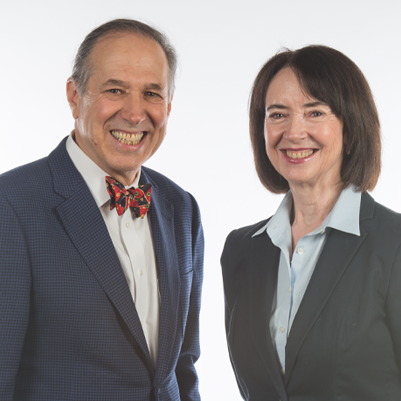
On this special 2025 Rewind and Look Ahead episode of “Conversations on Health Care,” hosts Mark Masselli and Margaret Flinter turn their focus to the breakthroughs, discoveries and innovators shaping what comes next. “Health innovations and breakthroughs that seemed impossible years ago became closer to reality in 2025,” says Mark.
We revisit pivotal conversations with leaders driving real-world change, including:
- Samantha Hutten (Michael J. Fox Foundation) on accelerating Parkinson’s research
- Dr. Nora Volkow (National Institute on Drug Abuse) on addiction science and policy
- Drs. Robert Pearl and Brian Anderson on the promise and risks of AI in health care
- Dr. Kenneth Cooper, whose prevention-first vision is influencing modern care models
We also learned about major developments in Long COVID research, including global studies and clinical investigations aimed at understanding its causes and long-term impact.
(00:00)
[instrumental music plays]
Mark Masselli (00:04)
Health innovations and breakthroughs that seemed impossible years ago became closer in reality in 2025. And
we talked with many of the policymakers and influencers at the forefront of these changes.
Dr. Brian Anderson (00:18))
Last year, we learned a lot. And I think one of the, if I'm being honest with myself, one of the maybe appropriate
criticisms of chai in the work that we did was that it was very technical and it was very detailed. We published a
responsible AI guide that's 187 pages long. and so that can be a challenge if you're a small community health
center looking to deploy AI in a responsible way. And so, I think we've, we've heard that criticism. I've taken
that to heart. And so this year, we're going to be focusing on a major strategic effort working with federally
qualified health centers, community health centers across the nation to take the body of work that we've created
over the past several years, and develop playbooks that are much more accessible and usable to the lower
resourced community centers, be them in rural Appalachia or, you know, inner city LA.
Margaret Flinter (01:12)
We also heard from the researchers who are unlocking the mysteries of everything from Parkinson's disease to
substance use disorders.
Dr. Nora Volkow (01:20)
The notion that we're seeing a significant decline in mortality from overdose. And that is very different from
what we have been seeing for the past two decades, where everything is going up and up and up. And since
2023, we're starting to see it go down how much? Down 26% in one year. So, it is large and consequential, so
that's very, very Exciting.
Mark (01:41)
And, and why? Why is it going down?
Dr. Volkow (01:43)
I think that the answer is multiple causes. It's not just one single one that is responsible for it. I, I would say that
an important one has been a very aggressive campaign to distribute and make available the medications that we
have to prevent people from overdosing, which are the medications for opioid use disorder, to treat people that
are addicted to opioids with them. Methadone, buprenorphine, naltrexone.
Margaret (02:06)
This Is Conversations on Healthcare.
(02:08)
[instrumental music plays]
Mark (02:19)
Well, welcome back to Conversations on Healthcare and our 2025 Rewind and Look Ahead program. You
know, long COVID has been an important topic to many of our, of our listeners as well as to us. And in 2025,
there were setbacks. The National Institute of Health canceled many of the grants under the recovery initiative,
the main federal program, studying long COVID biology, yet over 400 million people, Margaret Worldwide, are
still living with the effects of long COVID. New research showed that for older adults, the consequences may be
profound and lasting. We interviewed a leading researcher about his global study of over 3,500 patients.
Dr. Gabriel de Erausquin (03:03)
The importance will depend on whether what we have, found generalizes. And what I mean by that is, remains
true, over the long term. The data we have now, overwhelmingly are from one or one and a half years after the
original infection. And we're now long past that, data, the timeline. and what we need to figure out, and we're
doing studies currently to address that question, is whether what we found, in that initial sample set of samples
is stable, meaning it remains, the same has gotten worse or the, or the, the impairment has become progressive
or has recovered to some extent. And that is really the crucial question. Most of the indications we have from,
follow up data are that it is either the same or progressive. we don't see recovery in older adults. We do see
significant recovery in folks under the age of 60, but not in, people over the age of 60. So, what this implies is
that if assuming it remains true, the- it implies that, the, the likelihood of developing significant cognitive
impairment, which is already a public health problem. As you might know, the rates of dementia in the adult
popul- older adult population in the United States and worldwide, because of the aging of the population itself,
have increasingly become a, a public health concern and are only likely to increase over the next 10 or 15 years.
this would imply if it remained true, as I suggested, that, the, the magnitude of that crisis is at least two times
greater, if not more.
Margaret (05:18)
We also spoke to the co-director of Northwestern Medicine's Comprehensive COVID-19 Center. Dr. Igor
Koralnik explained how they're investigating potential causes.
Dr. Igor Koralnik (05:30)
Different, etiologies have been entertained for, the root cause of long COVID. And they're not mutually
exclusive. They may, you know, be together at the same time. So viral persistence is one, the virus remains
hidden or dormant in some places in the body and needs to be treated with antiviral medication. The treatment
of Paxlovid, at least in these two, smaller studies for 14 to 20 days, was not efficient. We will wait for the result
of this larger study that is now we, we enrolled patient at Northwestern in many sites in the country. And we
will, wait for the result of this study. That's one thing. Another is autoimmunity. The virus comes and confuse
the immune system, that there's something abnormal, abnormal in the body that needs to be attacked. We, see
that in our clinic and in every post COVID clinic, actually, there is a, a predominance of, women. So, two third
of the patients are women, and we know that women are more likely than men to develop other autoimmune
disease like multiple sclerosis, rheumatoid arthritis, lupus, and so on. And we see also an enrichment in the
patient population of people who had prior autoimmune disease before COVID-19. So there probably is an
autoimmune predisposition. We are working on this in my lab. Other labs are also looking at this. so far there is
no, medication or immunomodulatory medication that has come out of this research, which is still ongoing.
Third possibility is that long COVID is caused by a microvascular disease. And, you know, that the spike
protein of the virus can bind the ACE two receptor on the surface of endothelial cells, for example, lining the
blood vessel and can trigger some inflammation or even infection of these cells. And we are- have published
recently a study looking at the microvascular, structure of the retina in the back of the eye using a,
ophthalmological technique called optical coherence tomography angiography with, a lead ophthalmologist here
at Northwestern, Dr. Manchu Gil. and we have seen a decrease in the caliber of very small vessel in the retina in
patients with neurologic complication of, COVID-19. And so, it is possible that this decreased perfusion that we
see in the eye is actually a window on the brain and other organs and could, could cause some of the
symptomatology that the patients have.
Mark (08:21)
Of course, healthcare affects us all at an individual level. One of the biggest names dealing with health
challenge is Michael J. Fox. Over 25 years ago, he announced he had been diagnosed with Parkinson's disease.
Since then, he's devoted his talents to eliminating Parkinson's in our lifetime. Samantha Hutton is a
neuroscientist and vice president of the translational research at the Michael J. Fox Foundation. She shared
details about their Parkinson's progression marker initiative.
Samantha Hutten (08:53)
And The idea here is that if we can detect Parkinson's earlier, we can treat it sooner. Hopefully one day we can
prevent the disease altogether. So, in the 15 years since PPMI, started, it's really become the cornerstone of PD
research. we have, over 3,400 participants to date. And PPMI, this is continuing to grow. It's very impressive.
These are participants who come to around 50 clinical sites around the world. these are newly diagnosed
individuals, those who have a family connection to Parkinson's disease. people with risk factors for potentially
developing Parkinson's, like loss of sense of smell or sleep disorders, as well as healthy volunteers. And today,
PPMI is still going strong. So, there are some folks who have been in the study for 15 years now. they come in
for regular visits to participate in clinical testing, brain scans. They donate their bio samples like blood and
spinal fluid. and this is the, the cornerstone of the new biomarker breakthrough that you mentioned, which is,
now able to detect, pathology associated with Parkinson's disease in living people. So, as I mentioned,
biomarkers tell us things about diseases. for other diseases like cholesterol or heart disease, we have things that
can reliably, detect the pathology and then tell us with a hundred percent certainty whether somebody has a
disease or doesn't. So, things like A1C for diabetes, cholesterol levels for heart disease, pregnancy tests. We
haven't had that for Parkinson's disease until now, which is why this breakthrough is so exciting. so, I can tell
you a little bit about the biomarker, which is called the alpha-synuclein seed amplification assay, or alpha-
synuclein, SAA for short. It's a very long name. but you probably know, alpha-synuclein is a protein that
accumulates in the brains of everybody with Parkinson's disease. It's the pathological hallmark of the disease.
And to date, it's been very difficult to measure this in living people, especially the aggregated or clumped up
form that occurs in the brains of people with Parkinson's. So, we funded work on this biomarker over the last 10
years. it's essentially a very novel way to measure, with clumped up alpha-synuclein in a person's spinal fluid.
So, somebody comes in and they donate their spinal fluid, and then we can measure this pathological alpha-
synuclein using a test that actually turns out to be over 90% accurate, for diagnosing people with Parkinson's
disease. And the really, really cool thing about this test is that it doesn't only detect, alpha synuclein,
pathological alpha-synuclein in people with Parkinson's disease, but it's actually quite accurate in being able to
identify people who later go on to develop Parkinson's disease, even before they have manifest symptoms. So
that's the, the test in a nutshell. And we're really excited to have been part of this advancement in biomarker
research.
Margaret (11:49)
Former Republican member of the US House, Mary Bono from California is another high profile name who's
taken on a health advocacy role. She explained how her late husband, Sonny Bono and her son both struggled
with substance use issues. And that motivates her today in her role as the co-founder and the honorary chair of
Mothers Against Prescription Drug Abuse.
Honorable Mary Bono (12:12)
This is very personal, and I have been affected by substance abuse disorders and my family, you know, my
whole life. And that runs on, on, both sides and through marriages and all sorts of stuff. And the, the point thing
here is it can happen to anybody. I was a sitting member of Congress when it happened in, in my family, which
is pretty mind blowing when you think about it. That here she's crusading on this. And then here it is happening
in, in my own family. So, I used to say, when I was in Congress, there are things that you are, and things that
you do. And this one, for me was deeply personal and obviously preventable. So, I did champion it and talk
about it. And, you know, my campaign chairman when I first ran for Congress and throughout my, my 15 years
originally was President Ford. And then when he passed, Betty Ford became my campaign chair. Mm. And she
was always a beacon of hope for me on these issues of removing stigma from people who have a substance use
disorder. And, you know, getting treatment is okay. So, I thought talking about it publicly was important for a
couple of reasons. Number one, if this happened to my family, it can happen to yours. And then number two, to
say there's, there's nothing wrong with a, with asking for help when you, when you're ready and when you need
it. So, it, you know, again, great mentor leadership in, in Mrs. Ford.
Margaret (13:37)
Absolutely.
Hon. Mary Bono (13:38)
It's a great role model for me.
Mark (13:40)
In terms of addiction issues, one of the most exciting conversations in 2025 was with the director of the National
Institute on Drug Abuse. Dr. Nora Valoff predicted how close we are to curing addiction. When we spoke to her
at Aspen Ideas Health.
Dr. Nora Volkow (13:57)
We have been funding research. I, as I mentioned more than a decade ago, in animal models, it stops them from
drug taking these GLP drugs. But there's also, two randomized clinical trials in alcohol showing that people stop
drinking, reduce their drinking behavior. there we've been funding also studies for tobacco is reducing tobacco,
the data, the, the clinical trials were not as large. So, and we're doing studies with opioid addiction and we're
doing studies with cannabis, and we're doing studies with cocaine and methamphetamine. It looks very
promising. And so that is another aspect in terms of developing medications that right now, and, and I don't
think I ever been as excited about the opportunities that we have. We have the GLP, which also have already
been given to humans. So, if they show to be effective, we could bring them into the market relatively rapidly.
But the other one are psychedelics. I was speaking about the issue of neuroplasticity, right? So, the whole
concept is, are there drugs that we can use to open up those neuroplastic windows? So, think that our brain
changes faster, and we can do those changes within a context that you can do, for example, a cognitive
intervention, or you can use neuromodulation, which is another aspect that of technologies and tools that is very,
very exciting and promising. So, through it, you can fine tune certain secrets and linkages that may be disrupted
by addiction, for example, or strengthen those that you know are necessary for you to improve your ability to
self-regulate desires and emotions. So, if you think, and that's what I was trying to say with a big idea,
combining these different elements and tools that we have. So that's where I can see the future into addiction.
And, and that's why I say I, I would have never, ever in my life there to say, we're going to cure addiction. I
think that we now have knowledge. And tools that could potentially definitively lead us to a cure of addiction.
Margaret (15:57)
Well, Mark the future is indeed exciting. We talked to Dr. Robert Pearl, who co-authored the book chat, GPT
MD with the help of generative AI. He says, the tech strength lies in its access to the entirety of medical
knowledge.
Dr. Robert Pearl (16:13)
First Of all, I wanna tell viewers and listeners that all profits go to Doctors Without Borders, a great charity has
had the profits from all my previous books. I wrote it because as you knew, November 30th, 2022, the
generative AI chat PT was released. Now I named it Chat, PT md, my book title 'cause it flows so beautifully.
But everything I'm about to say about chat, GPT is just as true about Gemini from Google, just as true as Claude
from Anthropic, and the most recently released Chinese Deep Seek model. But what I realized is that this is an
exponential technology in that way. It's very different than something like the electronic health record. An
exponential technology actually like a coronavirus doubles every year. And in this situation, the technology,
Chat GPT would be 32 times more powerful in five years. And in fact, if I went through the typical cycles I had
with my previous books of going through a traditional publisher and writing it on my own, it would've taken
about two years by the time the technology's four times as powerful and everything I write would be outdated.
So, I said, how do I increase the speed, accelerate the writing and distribution process? And I decided that the
way to do it, and by the way, an interesting way to do it would be to work with chat GPT so that I could
firsthand experience this generative AI tool, not just in clinical practice, but also in the creation of artistic work.
And I approach it the same way I do with a resident or a medical student with whom I'm write a paper. This, in
this situation, I gave cha GPT, the 1.2 million words that I had written and published. I would normally give a
bunch of articles to a medical student or resident. And then we exchanged draft back and forth, probably 30
different drafts per chapter. There's six pages in there. I should point out that were written only by chat, GPT, or
mainly by chat, GPT. And I highlight those so readers can see how the technology itself would work. But all the
others were, I'll call it, a collaborative effort and represents a combination of the voices that were there.
Mark (18:32)
Margaret, of course, 2025 will also be known as the year where no interview didn't have a question about AI. So
that was very fascinating to hear, from him. Tech advancements also require rules and regulations. We heard
from Dr. Brian Anderson, the CEO of the Coalition for Health AI, about how his organization is working to
establish clear guidelines for responsible AI in healthcare.
Dr. Brian Anderson (18:59)
Let me start with one of the, kind of, the very basic principles in responsible AI, which is transparency. the
example or metaphor I like to use is when you and I go to a grocery store and we, you know, look to buy a can
of soup, and we want to know what's in it, we turn around the can of soup, we look behind and we see the
nutrition label, and we know, you know, how many carbohydrates, how much protein, how much fat is in it,
what the ingredients are. We have that kind of understanding because we have an expectation of the
transparency that we, we get to know about the things that we're gonna be buying at a grocery store. One of the
challenges in AI and in particular in responsible AI, is a common agreement on the level of transparency for the
customers of AI in partnership with vendors to understand how these models are built, what kind of data sets
were the models trained on. As a physician, myself, I might be very, concerned about knowing if a model was
trained on a particular kind of patient that I might have in front of me. Was it, was it trained on this kind of
patient? Is it appropriate for the patient that I have in front of me? Not having that kind of transparency, not
having that assurance that these models are trained on the kinds of people that I as a physician or a nurse might
be serving Is, is a real challenge to building the kind of trust. And so when we did this work, we brought
together the vendor community, so big tech companies and small startups as well as their customers, namely
health systems and, and payers and health plans, and said, okay, what is the minimum threshold of transparency
from a responsible AI standpoint that the vendors and their customers can agree to in what we've now called an
AI nutrition label or our model card? That that is that base level of answering questions like what's in it, what
are the, the data sets used? What are the indications? What are the limitations of using these kinds of model?
And so, it's that kind of hard work building to a technical level of specificity. So, getting from the 50,000 foot-
you know, we all want transparency, we all want safety, but what does it actually look like? And so that's the
work that we've been focused on. That's some of the examples in the assurance standards guide.
Margaret (21:07)
Mark, one of our most inspiring conversations in 2025 was with the man known as the father of aerobics. Dr.
Kenneth Cooper, loved him, loved him, joined us at age 94. Dr. Cooper remains a passionate advocate for
reshaping our national approach to help particularly through the lens of prevention, a theme at the center of his
book, grow Healthier as You Grow Older, relevant for all of us.
Mark (21:32)
And he will be back on his hundredth birthday, I'm sure.
Margaret (21:35)
We hope so.
Mark (21:36)
With as much vim and vigor.
Dr. Kenneth Cooper (21:37)
Let me tell you what happened because it took me half my life. I wouldn't even be here today because in, in high
school, I was an athlete, made all-state Oklahoma, I made all-state basketball, I won the state champion in the
mile. I got a, a scholarship to the University of Oklahoma. I weighed 168 pounds during my athletic career. But
then I got into medical school, and I discovered that obesity is the most common manifestation, manifestation of
stress. So, I started gaining weight just to keep a awake at night. My internship made it worse. By the time I
been finished my internship, I'd gone from 168 to 204. I weighed that much. And then for six years, I waited in
the Army. I was referred for the, the draft. So, for years, six years, I didn't realize back in those days that
exercise had a health factor. Exercise was just competition as far as I knew about. And so, in my obese state, 29
years of age, I went water skiing. At that time too, I was hypertense and I had pre-diabetic condition just
because of my obesity. Halfway through the skiing up here at Lake Tech Home, I got hit with chest pain and my
heart started racing outta my chest. So, they got me over the side- I'm still in the Air Force- my heart rate came
back to normal. And so, they got me the, got me the next day about a school of aerospace medal for the
complete examination. And they said, doc, only thing wrong with you, you're outta shape. And here at I'd gone
up at, at 29 years of age, I was overweight and active, but all the things that I mentioned, all that. And so, I
changed my lifestyle. I planned on becoming an ophthalmologist after I finished my internship. But when I lost
the weight within six months from my first marathon- I rand the Boston Marathon twice and 30,000 miles over
40 years. All that disappeared. I thought, this is a field of medicine that sadly ignored. So, I changed my
direction. That was epiphany from God as far as I'm concerned, that made me change my direction from
becoming an ophthalmologist, become a specialist in preventative medicine when I was advised to not against.
And look what happened. We have a full, full-time- we have 31 physicians on staff. We have eight different
subspecialties here, and we have people we can't even handle, people waiting in lines.
Mark (23:35)
Dr. Cooper Gives us great motivation for tackling our New Year's resolution. We look forward to more guests in
2026, like Dr. Cooper, who are influencing how we think about our healthcare system and the ideas and policy
that fuel how it works.
Margaret (23:52)
So just a reminder, be sure to subscribe to our videos on YouTube. Find us on Facebook and X with our account
name, CHCRadio. As always, you can go online to chcradio.com and sign up for email updates, and please
share your thoughts and your comments about the program with us. Happy holidays. Happy New Year
everybody.
Mark (24:12)
And Margaret, just a special shout out to our, our overseer who really keeps all of this of us going. Adam
Shapiro, Leslie Gianelli, and in our studio, CJ and Dan, thank you all. They've made us, made us look much
better.
Margaret (24:29)
Happy New Year.
(24:30)
[instrumental music plays]
Margaret (24:33)
This copyrighted program is produced by conversations on healthcare and cannot be reproduced or remitted in
whole or in part without the expressed written consent from Community Health Center, Inc. The views
expressed by guests are their own, and they do not necessarily reflect the opinion of conversations on healthcare
or its affiliated entities.
(24:55)
[instrumental music plays out]