What Fmr. President Obama Told Our Guests About His Big Health Care Misstep
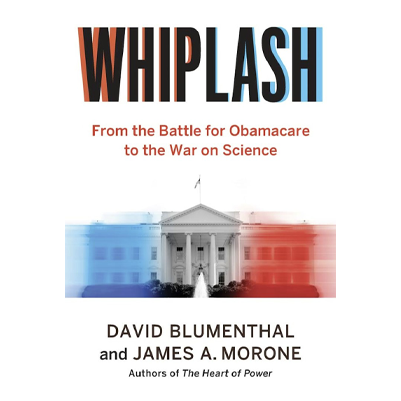
The authors of a new book reveal that former President Obama told them that he had an “inability to boil issues down to their essence, to tell a story…” and explained how it hurt him as he tried to pass the Affordable Care Act.
This insight and others are at the core of Dr. David Blumenthal and Jim Morone’s book, “Whiplash: From the Battle for Obamacare to the War on Science.”
Such observations will be heightened in the coming weeks as the Obama Presidential Center prepares to open, which will look back at the decisions, tensions and turning points that reshaped U.S. health care.
Hosts Mark Masselli and Margaret Flinter explore with the guests the 15 years when health policy shot to the center of America’s partisan wars. They write about the following leaders:
- President Trump: His administration’s work on vaccines through Operation Warp Speed “set a model for how future administrations can tackle technical challenges during crisis”
- Former President Biden: His overlooked public health legacy and where he went off course in his public role
(00:00)
[instrumental music plays]
Mark Masselli (00:04)
Does recent history feel like a case of whiplash to you? It does to two noted public health experts who use the
word “whiplash” in their new book that examines the time from Obamacare to COVID.
James Morone (00:17)
The ACA started a great battle. Healthcare had always been contentious, but it became even more contentious.
Obama stood for the new diverse nation that was rising up, and while we were thrilled at the fact that he was the
first African American president, the fact that he represented this incredible diversity, we didn't notice how there
was another America that was not thrilled.
Margaret Flinter (00:47)
Joining us today are Dr. David Blumenthal and James Morone, who are reflecting on the 15 years when health
policy shot to the center of America's partisan wars.
Dr. David Blumenthal (00:57)
One of the things we learned is that Americans are incremental in their politics and in their reforms. The best
way to get to universal coverage now, the most practical way, you can do it with 50 votes through
reconciliation, is to build on the Affordable Care Act and Medicaid and Medicare.
Margaret (01:17)
This is "Conversations on Health Care."
Mark (01:30)
Well, Dr. Blumenthal, welcome back to "Conversations on Health Care," and James, welcome for the first time.
James (01:35)
Yeah, I'm delighted to be here.
Mark (01:37)
Oh, that's great.
Dr. B (01:38)
Thanks for having me again.
Mark (01:39)
Yeah. Your book is titled "Whiplash: From the Battle for Obamacare to the War on Science," and Dr.
Blumenthal, your book includes an exclusive interview with President Obama about the Affordable Care Act.
And Margaret, last year, we had this opportunity at Aspen Ideas: Health to hear from Nancy Pelosi, Secretary
Sebelius, and Secretary Burwell, so we're really excited to really hear from the main man. So that's exciting.
And also, we know that President Obama's new museum, a center in Chicago, is about to open. But Dr.
Blumenthal, what did President Obama tell you?
Dr. B (02:25)
Well, he is a remarkable person, and he told us in his own inimitable way some things that surprised us and also
were deeply human. So first of all, he started out by saying, knowing that we are kind of healthcare nerds, that
he didn't really want to do exactly what the Affordable Care Act was, but he would've preferred to start from
scratch and do Medicare for All. But the Affordable Care Act was what was possible. He called it a Rube
Goldberg machine, and that's what it is. But it is a uniquely American solution to our coverage problems. So that
was one thing that he impressed upon us. Another thing was, we had gone in with a question about why this
young president decided to do this incredibly risky healthcare project right out of the box in his presidency and
basically put his entire presidency and his legacy at risk. And he was told by everyone around him who had
gotten him to the Oval Office to stay clear, to not touch healthcare with a 10-foot pole, because it was a
graveyard for presidential power. Joe Biden didn't want him to do it, David Axelrod didn't want him to do it,
Rahm Emanuel didn't want him to do it. David Plouffe didn't want him to do it. None of his advisors who had
gotten him to the presidency told him it was a good idea. They wanted him to do energy or climate or tax reform
or economic policy, something else. So, we were really curious about why he did this thing. I would not have
done it if I had people like that telling me it was a bad idea. And we gave him a bunch of choices, and the one he
told us had motivated him, and this is where it's personal, was his mother. Right. Her experience dying of
cancer, fighting with insurance companies, deeply affected him and made healthcare his number one priority.
And when he signed the bill in front of his staff, he said that he was signing it for his mother. So, this was, for
us, a revealing moment. It was not totally surprising because we wrote a previous book called "Heart of Power:
Health and Politics in the Oval Office," in which we documented the extent to which modern presidents have
been shaped by their personal healthcare experiences, mostly by their families. And this was another example of
that. The family healthcare experiences of presidents change history, and we should never forget that they are
humans, and they are affected by healthcare. They cannot escape it. They can escape poverty. They can escape
homelessness. They can escape food insecurity. They can escape service in the military. But they can't escape
healthcare.
James (05:49)
Well, quick follow-up to that. The thing that struck us last time was how little their own health mattered to them.
They're so keen, every one of them, to prove that they're strong Yeah ... in control that when they get sick, they
brush it aside, but when someone they love gets sick, it changes everything for them. And I think not a single
presidency was not affected, Democratic or Republican, was not affected when a loved person got sick.
Kennedy is a great example. He got the last rites of the Catholic Church four times as an adult. Joe Biden did as
well. And it didn't matter to him. He was tough, but when his father got a stroke, suddenly Medicare, which was
not particularly important to him, became central. He wanted to hear about it every day in his personal briefing.
So, it's really the personal that becomes political in healthcare.
Margaret (06:49)
Well, the two of you have just accomplished catapulting us right back a couple of decades to that moment in
time, and I'm so glad to have you today for this conversation because it was a powerful time and a lot of
important lessons in it. But maybe just one more question about your experience during that time, and David, I
think you noted that President Obama told you he had an inability to boil issues down to their essence and to tell
a story. It's ironic because it seems to me-
Mark (07:21)
He's a storyteller.
Margaret (07:22)
... that you just told the story that really captured the essence of healthcare and your family and insurance
companies. Where does that fit in with health and healthcare? How important did that become to the theme of
your book that he had this difficulty boiling things down to their core issue?
Dr. B (07:43)
Well, he almost lost the Affordable Care Act over this- Oh, we remember ... inability. Yeah. There were times
when he was tasked with bringing the debate back from the Tea Party, back from the overhang of race, back
from the anger over government, back from death panels to the essence of what this was about. And it was about
people. It was about his mother; it was about other people suffering. But he got lost in the professorial thicket of
healthcare costs, and he would go on and talk about the cost curve and bending the cost curve and how to
change insurance companies and how to change payment policy. He loved this stuff. He was a professor. He's a
brilliant man. It was a Rubik's Cube that he just wanted to figure out how to solve. The problem was the
American public didn't want to hear that. They wanted to hear why it mattered to them and to their families. And
at times, he just lost that thread. But in the crunch, when it really mattered, his eloquence and his charisma was
often decisive. And Jim tells a wonderful story about his address to the Democratic caucus at the last moment
when he had to get the House to accept the Senate bill, to basically close their eyes, hold their nose- Yeah ... and
vote for the Senate bill. Jim, you want to tell that story?
James (09:34)
Yes. Before I do, Obama was really caught between the inside game. He was so desperate to have a few
Republicans support the legislation. After all, they had voted for things very much like Obamacare, very much
like the ACA, in the past. And so that also made it more difficult. Not only was his mind seeing complexity, he
would motion the Rubik's Cube while he talked about healthcare, but he also censored himself because he was
trying to talk budget with a few Republicans like Olympia Snowe of Maine. However, when the chips were
down, his eloquence returned, and no time more dramatic, I don't think, than the one David refers to. The House
and the Senate have already passed legislation by December of the end of his first year. And then they have to
get together because every comma has to be the same in the two bills, and they hate each other's bills. The
Senate bill is far too conservative for the House Democrats, and when they get together, they start to scream at
one another. Obama, who's presiding, trying to get them to agree on a single package, loses his temper for the
only time on record. He says they're acting like children, but nevertheless, they can't agree. Then, in a special
election in Massachusetts, for Ted Kennedy's seat, Ted Kennedy had died the summer before, the Democrat,
Martha Coakley, lost to a Republican named Scott Brown, whose campaign issue was, "I will stop Obamacare."
And because that gave the Democrats only 59 seats, they could no longer break a filibuster, and so these two
different bills could not be renegotiated. That seemed like it. Barney Frank of Massachusetts, one of the leaders
of the progressive caucus, said, "That's it. Bill's dead." Obama then went to the House and said, "Look, the only
choice now is to pass the Senate bill." Yeah. We talked to congresspeople who said they knew voting for this
bill was the end of their political careers, and indeed, many of them were wiped out in the midterm a few
months later. Careers that were rising a year earlier were now over, and apparently Obama gave one of the most
beautiful speeches. Several congresspeople told us that they were pretty solidly no, and then they heard Obama,
who said, "We are here not to get reelected, but to do some good. And this bill, even though it has flaws, is so
much better than the status quo. You can make a difference in the world. You can make a difference for
healthcare in America, and it's a good trade-off to do that. I may be a single-term president as a result, you may
be single-term congresspeople, but that's why we're here." And some of the staff members said it was so
eloquent that that tipped the Democrats in the House and they passed the Senate bill, which, while they didn't
like it, was far better than the status quo. So, Obama was not able to address the nation on what made on
bringing people along, but when he needed to, he addressed the House in those grand, moral terms that really
saved the legislation for the third or fourth time.
Mark (13:17)
Well, there was no one better than him in saving the legislation. When we heard from Pelosi and Sebelius and
Burwell about their rendering of this, and I think Nancy said that we finally had to get the nuns to write the letter
because the bishops refused to write the letter. The nuns wrote the letter.
Margaret (13:34)
Yay for the nuns!
Mark (13:35)
And this moved it forward. But James-
James (13:36)
50,000 nuns supporting that legislation when the bishops refused.
Mark (13:44)
That's right. James, you approach the book by looking at this 15-year timeframe from 2009 to 2024. I'm
wondering, what connections did you make? Are you implying that the ACA may have resulted in what is
today, or what seems like a war on science?
James (14:02)
The ACA started a great battle. Healthcare had always been contentious, but it became even more contentious.
Obama stood for the new, diverse nation that was rising up, and while we were thrilled at the fact that he was
the first African American president, the fact that he represented this incredible diversity, we didn't notice how
there was another America that was not thrilled. That Donald Trump managed to awake as he went from studio
to studio saying, "He's not even American. He's not legitimate." And those two visions of America itself got
wrapped up in healthcare. Now, it has always been contentious, as you well know, and what a great debate it is
whenever we try to increase coverage. But that definition of Americanism has really made things very hot. And
then when Donald Trump confronted COVID, and again and again, his health team said, "No, you can't say that.
No, bleach will not solve this." Donald Trump did not want to hear naysaying, so he became very angry at his
health team. And when he lost the election, the whole notion that there was a deep state opposition to him,
partially for, and we can talk about this later, slow walking, in his view, slow walking the vaccine. What had
been contentious about coverage moved over, for the first time in many, many years, moved over and became
contentious about healthcare and science itself. The scientists slow walking the vaccine became part of the story
of why Trump had lost the election, or if you will, had had the election stolen from him, and that made science
itself part of the great battle. That was part of the history. It started with the great intensity of the battle for the
ACA, but it really got on steroids- Franchise ... during the COVID epidemic and Trump's loss that was seen
partially as the result of scientists resisting what Trump had to say.
Margaret (16:25)
Wow, we're really reliving history here. And, David, we've had Dr. Fauci on our show, I think five times,
probably the most frequent person, throughout COVID. He was such a powerful voice then. But you wrote that
there's an incorrect narrative about scientists' failures during COVID, and how would you want to set the record
straight about that incorrect narrative?
Dr. B (16:51)
Well, it was hard to deal with COVID. COVID was a new organism. Yeah. We didn't know how it would
behave. We didn't know that it would become a mutating acrobat with constant new genetic forms, with
different viral properties, different pathogenicity, different transmissibility. So, it was a tough one for science to
deal with. And when President Biden talked of following the science, I think he and his advisors didn't realize
that science would have to be so changeable. But it was, and that's not the fault of the scientists. What they
might have been blamed for, and Tony Fauci feels like he did his best to qualify what he was saying at any
given time, and I think some people feel the scientists could've done better in making clear that they were giving
tentative advice, not definitive advice. So, I think there's a communication agenda with respect to science that it
would be ideal if scientists could learn, and that is how to communicate more effectively. But I also think that
on the other side, the Operation Warp Speed was an enormous historic triumph of science. Exactly. And saved
millions of lives and trillions of dollars. And it is ironic that this enormous success got mixed up in the attacks
on science. During the period running up to the availability of the vaccine, we tried lots of things to reduce the
impact of COVID. We tried shutdowns, we tried closing schools, we tried masking. We've never done a full
postmortem on COVID, a full objective fair, non-partisan evaluation of all the things that we undertook. Yep.
Closing schools is often condemned because children, it turns out, were not particularly susceptible. They did
get sick, they did die, they did suffer long COVID, but not at the same rate as older Americans and especially
elderly adults. But what we forget is that there is only one place in our society, or any society, where millions of
people come together in close proximity, five days a week, nine months a year, and that is in school rooms.
Yeah. And they did not get sick, but they got infected, and they spread the infection. So, closing schools was a
logical thing to do. Right. The problem with opening schools is that you had to figure out when it was safe to do
it. We didn't have testing. We didn't have testing, in part, because the CDC test failed. Failed, right. But also,
because we had a president who didn't want people tested and said so again and again and again. So, it was very
hard to be rational in opening schools or opening communities. We need that postmortem. Yep.
Margaret (20:40)
Absolutely.
Mark (20:41)
James, I want to sort of shift to President Biden because you conclude that Biden had an overlooked public
health legacy. I'm wondering what you think he did right, and where did he go off course?
James (20:54)
He did two things that were extraordinary. One, he got 200 million jabs into arms in 100 days. It was an
extraordinary mobilization of capacity. Just stop and think about how difficult that is to do. And he comes in
from scratch. The vaccine, thanks to the Trump administration, was in hand, but getting it from that hand, that
federal hand, across the country, an extraordinary feat, really. And so, he did that right. And the other thing he
did right was he got aid, starting with Nancy Pelosi during the Trump administration, but then after that, he got
assistance to the American public in an extraordinary way. We say in the book that this was the most far-
reaching war on poverty since the New Deal. Wow. And during COVID, Americans were saved, really, by this
war on poverty. To just give you one example, the child income tax credit brought millions of children out of
poverty. We went into COVID with child poverty rates roughly equivalent to Mexico, a much poorer country.
And during COVID, our child poverty rates dropped to the equivalent of Switzerland and Germany, really the
national exemplars of treating children well. The Biden administration did that. They couldn't keep it going.
They lost that Joe Manchin vote. They could only get 49 votes, and so it went away, and Joe Biden really
suffered for that. Suddenly, people were in very dire condition as a consequence, both of the economy and of the
end of that social welfare. So, what he did right was both mobilizing COVID and getting aid to the American
public. What he did wrong, terribly wrong, was he didn't publicize it. Ironically, the same problem Obama had.
Particularly as he got older and infirm, he didn't go out and tell people exactly what was happening. David was
just saying that this was a problem for scientists, the inability to communicate in ways that resonated with the
media. Well, it should never be a problem for a politician to do that, but Joe Biden-
Mark (23:26)
And particularly the President of the United States.
James (23:27)
... is telling the story.
Margaret (23:31)
Well, James, I wonder if we stay on this a little bit, you analyzed the interconnection of race and class in health
policy from Obama to Trump. Tell us more about the picture you've drawn there, the argument about that
interconnection.
James (23:48)
We were surprised, and it shouldn't have surprised me as a political scientist, but both of us were surprised at the
extent to which race played a role right from the start. Many of the people we interviewed from within Obama's
circle told us that they heard things that shocked them about race, and about the resistance to Obama as an
African American. There's one story that one of his aides told us, that he went out to Montana to go fly fishing
on a vacation, but stopped and did a couple of events before going off on vacation to support the Affordable
Care Act. And coming out of one of those two events in Montana, President Obama came, saw the Tea Party
protesters really for the first time. They were held at a distance, but still, he could hear them shouting. And he
got into the car, and his aide turned to him and said, "Are you okay?" And Obama was looking at them, and he
said, "I think they just figured out I'm Black." A line he would use repeatedly. That resistance was really very
powerful by all accounts. Now, let me quickly say that when we asked Barack Obama about it, he just brushed it
off, said, "It is what it is." But his aides didn't brush it off. Yeah. And that was an important part, I think, of
Trump's own rise, part of the secret. There's lots of things that appealed, the populist appeal of Donald Trump,
but there's no denying that one of them was a backlash against Obama. And so, the war on science, when it
came, when Trump's resentments led to a backlash against science, was driven in part, I think, by this racial
animosity that had been triggered. By no means do I mean to suggest, would either one of us suggest, that all
Republicans or all Trump supporters are racially motivated, but that is part of the package. And the Republicans,
I think, will have an important job to do to rid their party of this, frankly, toxin that now runs through it since the
Trump years.
Mark (26:08)
David, I want to look forward. If the Democrats today wanted to expand coverage, I'm wondering what one
lesson from the Obamacare should they not forget?
Dr. B (26:21)
Well, as someone who at one point in his career was all for Medicare for All, I nevertheless have to say that one
of the things we learned is that Americans are incremental in their politics and in their reforms. The best way to
get to universal coverage now, the most practical way, you can do it with 50 votes through reconciliation, is to
build on the Affordable Care Act, and Medicaid, and Medicare, and employer-sponsored insurance. Those four
programs or elements form the basis for universal coverage, American style. It's not pretty, it's not efficient, it's
not easy administratively, but it can be better than the alternative. It is better than the alternative, and I think
that's what the Democrats should focus on. In fact, it's what Biden did focus on when he came back to office. It
was on building in those extra subsidies and insurance premium supports, reducing the co-insurance deductibles.
Mark (27:37)
David, you mentioned American style, and I'm taken back, Margaret, to our conversation with David Gergen,
who was telling us that really, Americans can't really take the European models. They need something that's
American to latch on. And unfortunately, Obamacare has gotten so politicalized, but it is probably the solution,
because it's an American-grown solution, for all of its strengths and weaknesses.
Margaret (28:04)
Absolutely. Well, David, the debate over... Or, I'm sorry. Go ahead, James.
James (28:11)
I was just going to say, people are very fond, Washington insiders are very, very fond of saying that. Our view is
incremental is much easier. Incremental is politically plausible. The reason Americans have found it so hard to
make a big solution does not have to do, I don't believe, with American attitudes. After all, they said Medicare
was impossible for 20 years, and now you can't touch it. It has to do with the organization of our government. If
we were playing under the parliamentary rules of England, or Canada, or Germany, we would have a single
payer. So, Truman ran for it. Carter ran, Clinton ran for it. Americans have voted for a national health insurance.
So, I would downplay the extent to which it's attitudes and up play the extent to which it is that incredible
sausage-making machine in Washington that we have to get our health policies through. The result is the same,
of course, as David said, getting there incrementally is a lot easier.
Margaret (29:18)
Well, one thing that we know, it is a very important and powerful thing for people to go back and read the
history as you have reinterpreted it for people who lived through it. You've done a great service for us. We want
to thank you, Dr. Blumenthal and James, for joining us. Their book is titled, "Whiplash: From the Battle for
Obamacare to the War on Science." It's published by Yale University Press. We want to thank you. We want to
thank our audience for being here. And please remember to subscribe to our videos on YouTube, find us on
Facebook, but also, share your thoughts and your comments about this program. Take care and be well.
(29:53)
[instrumental music plays]
Margaret (29:56)
This copyrighted program is produced by Conversations on Health Care and cannot be reproduced or
retransmitted in whole or in part without the express written consent from Community Health Center, Inc. The
views expressed by guests are their own, and they do not necessarily reflect the opinion of Conversations on
Healthcare or its affiliated entities.
(30:17)
[instrumental music plays out]