Dr. Robert Pearl, CEO of the Permanente Medical Group

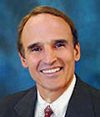 This week, hosts Mark Masselli and Margaret Flinter speak with Dr. Robert Pearl, Executive Director and CEO of the Permanente Medical Group, the largest medical group in the nation. Dr. Pearl discusses their use of pre-paid health care, system-wide, integrated electronic medical records and data mining to improve care delivery, improve outcomes and contain costs.
(Music)
Mark Masse ll i: This is Conversations o n Health Care . I am Mark Masselli.
Margaret Flinter: And I am Marg a ret Flin ter .
Mark Masselli: Well Marg a r et , we are now full steam ahead into 2014 . Over two
million people have signed up for insurance coverage through the insurance
exchanges , and while there are few glitches that still need to be resolved, the sky
has n’t fallen .
Margaret Flinter: One glitch that has gained significant attention in recent weeks
though has been a discovery that there wa s no provision to add newborns to the
existing family plans purchase d through the exchange. One of those very
specific glitches be e n identified will be work ed out but it does seem the biggest
issue affecting www.h ealthcare.gov has been worked out and that’s just being
able to access and navigate the site successfully and enroll.
Mark Masselli: Analyst s predict we will continue to see expansion this year of
provisions that will make the health care landscape more fertile for coordinated
care delivery.
Margaret Flinter: Well for sure, we think that we will see continue d growth in the
development of more partnerships, more creation of accountable care
organizations , patient - centered medical homes where care that i s consolidated
and coordinated is the norm and not the exception. And we hope we will see some improvement in outcomes and perhaps some shared savings in the situation.
Mark Masselli: I think it's wise to temper that expectation with some degree of caut ion. I think the industry analysts are expecting to see some mixed results
with ACOs initially but the trend is going to continue towards more coordinated care and that’s a good thing for improved patient - centered care.
Margaret Flinter: Well, that’s so mething that our guest today knows quite a bit
about Mark. Dr. Robert Pearl is the President and CEO of The Perman ente Medical Group, the largest physician - led system in the country serving more than
four million patients. They have crafted a model of ca re that shares the risk and the responsibility among all the medical professionals and patients within their
group to drive improvement in health outcomes. Very interesting model of how coordinated care adds so much value to the provider and the patient e xperience
of receiving care or delivering care.
Mark Masselli: Lori Roberston, Managing Editor of FactCheck.org looks at misstatements about health policy spoken in the public domain.
Margaret Flinter: But no ma tter what the topic , you can hear all of our shows by
Googling CHC Radio .
Mark Masselli: And as always , if you have comments , please e - mail us a t
www.chcradio.com or find us on Facebook or Twitter ; we love hearing from you.
Margaret Flinter: We will get to our interview with Dr. Robert Pearl in just a
moment.
Mark Masselli: But first , here is our producer Maria n n e O’ Hare with this week ’ s
Headlines News.
(Music) Maria n n e O’ Hare : I am Maria n n e O’ Hare with the se Health Care Headlines .
Health spending c ontinues its slow pace of growth. Health spending numbers
from 2012 were released last week and show historically low increases in medical prices and spending. About 3.7% increase in spending during that year compared to more than 8% annual growth in the early 2000s. Analysts aren’t
point ing to one specific cause for this slow down, not the Affordable Care Act
though its provisions are leading to more price transparency , t raditionally, health
spending slows during a recession and this time has been no di fferent . But there
is another fact or at play here th a n in recession s past ; t here is a higher
percentage of folks with high deductible insurance, meaning they pay more out of pocket for health care. Studies have shown definitively that these high deductib le plans lead people to hold off on elective and sometimes even necessary care because of the cost. Also Medicare spending is down largely
because the number of blockbuster prescription drugs like Lipitor ran out of their
exclusivity, meaning cheaper gene ric drugs became available to millions of
consumers leading up to 2012.
One thing that’s expected to grow in coming years due to the Affordable Care
Act , hiring in the medical professions . Analysts are predicting a spike in hiring
across the spectrum . H ealth care providers are going to be hiring more nurse
practitioners and physician assistants to meet the growing demands of millions of newly insured. And companies are now required to provide access to insurance and they will be seeking human services e mployees who are expert in health benefits management . Some Texas health executives are up in arms over limits
to the number o f health insurance exchange navigators in that state . Legislation
has been crafted that would exert greater demands on insurance exchange
navigators . Critics say it's an overt politically motivated attempt to hamper efforts
by navigators trying to educate Texans about their options on the federal health exchange.
The numbers of football players from the NFL now suffering from Alz heimer's ,
dementia in their 40s and 50s , an agreement is about to be approved that would
absolve the NFL of legal liability but set up a fund for those former players to be
compensated for taking years worth of blows to the head while working the
g ridiron.
And the letter of the week speaking of cognitive decline is the letter E as in
Vitamin E . Studies show that a daily dose of Vitamin E early in an Alzheimer's
diagnos i s proves prophylactic and protective in delaying worsening of symptoms.
The study publ ished in a Journal of American Medical Association show ed those
taking Vitamin E doses delayed worsening of the illness for as much as six
months to two years compared to those taking a placebo . More study is needed.
I am Marianne O’Hare with these Healt h Care Headlines .
(Music)
Mark Masselli: We are speaking today with Dr. Robert Pearl , Executive Director
and CEO of The Permanente Medical Group, the largest physic ian - led group in
the nation serving over four million patients. He is also Chairman of t he Council
o f the Accountable Physician Practices which seeks to foster the development of
the Accountable Care Organization s to improve health care . A Board Certified
Plastic and Reconstructive Surgeon , Dr. Pearl is also a Clinical Professor of
Plastic S urgery and Medical Economics at Stanford University Schools of
Medicine and Business . Dr. Pearl has published over a 100 peer review articles
and is a regular health industry blogger at www.forbes.com . He has been n amed
by modern health care a s one of the most powerful physician leaders in the
country. Dr. Pearl, welcome to Conversations on Health Care.
Dr. Robert Pearl: Good afternoon.
Mark Masselli: Since 1998, you have been at the helm of the nation’s largest
physician - led health care organization at Kaiser Permanente and your
organization is predicated on this principle that coordinated care is best way to optimize health care delivery. We sort of think of you all as an efficient, effective and a s an elegant health care organization. And for those of our listeners who
are not as well acquainted with your care delivery model, how does it differ from the typical primary care environment?
Dr. Robert Pearl: I think there are four ways in which it's different. The first is
integration . So we have multiple departments and the people in that department
work together as one, but it's also vertically integrated which means that primary care relate s to specialty care in a very direct way , and it ties into the secon d part,
which is the technology ; they share the same technology. We have a fully
electronic inpatient and outpatient record , so the information is available on every
patient wherever they may be at any of our 20 different medical centers , as you
sa id taki ng care of four million people. A third part that’s very different is that we
are prepaid . It can be very difficult. But what it does is it align s the interest of the
doctors and the patients because when you avoid a complication , you help the
patient a nd then your organization becomes more successful. When you in vest
in prevention you are able to accomplish the same . When you can offer
technological alternatives to hav ing to come into the doctor’s office , a ll those
pieces now start to align and again, that’s very different than the typical
community around us.
Margaret Flinter: Well Dr. Pearl, that patient electronic medical record that you
talked about , certainly you are one of the earliest major groups to convert into
electronic health records. I am wondering what your thought is with a patient
population of over four million. How have you used the electronic health records
to improve health outcomes generally for patients to make an impact on
population health with that incredible treasure trove of clinical data?
Dr. Robert Pearl: First is simply having data on every single patient. That means
the patient never has a problem with a doctor knowing what medications they are
on, what diseases they have, what laboratory information has been availab le i n
the past. The first thing is it gives us the opportunity to compare results across
what we call medical centers. The medical center, it takes care of about a
quarter million people and so we can compare each of our medical centers
against each othe r. And what we find is that in any given area , some are better
than others and what we can then do is learn from those who are doing it the
best. So a couple of examples, what we know for instance is hypertension and
across this nation i t’ s only controll ed about 55% of the time . We are about close
to 90% and that happened by an iterative process of learning from each other the
best ways to do that and the consequence i s about a 40% lower chance of a
patient developing a stroke.
So we are able to look at outcomes utilizing the (9:00 inaudible) in the fully
electronic medical record , and as an example of that in sepsis, what we found is
that find a day or two in advance that they actually had all the prerequisites for
ultimately developing a full blown sep sis. And by obtaining the lactate levels and
the other laboratory results, we can start treatment earlier and as a
consequence, again, across the nation, the mortality is about 15% to 20% and
we are under 9%. So it’s use of that data to be able to look a t large populations,
large numbers of patients and as a result of that, figure out something that works
better than the more traditional ways.
Mark Masselli: Well that number is so impressive. You are both a professor of
medicine of Stanford University, also teach medical economics in the school of
business, and sort of the transformation of health care systems really does come
down to economics. You say there should be incentives and rewards for
fostering wellness in patient populations. So what’s you r vision for shifting the
economic incentives in health care?
Dr. Robert Pearl: Well there is always incentive to get better at preventing
disease. And physicians are trained to treat disease, and so shifting the mental
mindset is essential. So how did the American health care system develop? It
developed in a very different world. There was not a lot of things that were
available to be offered to them. You can think about it very much as it being a
th
19 Century cottage industry. It was fragmented, it was fee for service which is a
piecemeal and obviously the technology wasn’t yet advanced. Now we are in a
world of chronic disease, multiple chronic diseases, and so the question now
becomes how do you shift doctor’s thinking around this. The first t hing as I
mentioned is prepayment. If you are prepaid to take care of a patient and you
can avoid whether it’s a new problem or whether it’s a complication of a problem
they have, then you are able to advantage both the patient and yourself.
The other ad vantage that we have is our average patient stays with us for over
17 years; in the community it’s only about five years. So we want to invest in that
prevention. And then finally, I think our organization attracts people who are
mission driven. When th e typhoon hit in the Philippines, we had over 300 people
volunteer to go there to provide relief and sent two teams. So I think mobilizing
all those different pieces, the prepayment, the ongoing relationship with
prevention and the mission driven (11:24 i naudible) can allow us to make that
advance in preventive care.
Margaret Flinter: Well Dr. Pearl, you have said yourself that this is a very critical
pivot point in health care. So we have the Affordable Care Act coming and all the
changes we are in but if I may, let me pull up as an example again this issue of
hypertension that you just talked about . And I am betting that there were other
people on this team as you think about pharmacists or behaviorialists or health
coaches, dieticians or nurses. May be tell us a little bit about what is that team --
what is potential with a Kaiser - like organization to prevent hypertension. Can
you speak to that a little bit?
Dr. Robert Pearl: Our results could not have happen ed without the remarkable
nurses and pha rmacists and other support people sitting in play. So we have
literally hundreds of nurses who are continually looking inside the medical record,
finding people who are not fully cont rolled and reaching out to them. We have
staff people looking at areas such as the cancer prevent ive areas to see whether
they have had it and be able to reach out to them. And again, this is where the
alignment comes into play because when you have that focus on prevention , you
make the kinds of investments that are necessa ry in order to reach out to people
proactively. So we could not get these kinds of results without th em .
But one thing that’s most interesting to me is every time a patient comes to our
offices , we print out for them, it's available online, it's availabl e on our prevention
app, all of the screening things they have not yet had. And the receptionist, the
person who is greeting them now looks at this. So if you think about the typical
office in the community, what’s the receptionist doing worrying about b illing,
worrying about coverage . What’s the receptionist doing in Kaiser Permanente ,
they are looking to see have you had your mammography, have you had your
colon cancer screening, have you had your cervical cancer screening, and
making sure you can get it done hopefully that day because you are already in
the medical center. And every month we have a ceremony where we honor
these people who have saved a life.
Margaret Flinter: Oh that’s so great.
Mark Masselli: That is great transformation.
Dr. Rob ert Pearl: Because they found someone who hadn’t had a mammogram,
went and ha d the ir mammogram and there was the cancer. And you can
imagine what that’s like for someone who is receptionist to actually have saved a
life. So the whole process becomes ver y, very synergistic.
Mark Masselli: We are speaking today with Dr. Robert Pearl, Executive Director
and CEO of The Permanente Medical Group, the largest physical - led group in
the nation. He is also Chairman of the Council of Accountable Physician
Practi ces which seeks to foster the development of the accountable care
organizations . So let’s talk a little bit about the work that you are doing at the
Council of Accountable Physician Practices and it's a consortium of kindre d
spirits, folks like Geisinger and Intermountain and others . Tell us about the
mission of this organization and the kind of influence you hope to have on the
larger medical community during this year o f reform that we a re in now in the
United States.
Dr. Robert Pearl: So the Council of Accountable Physician Practices was started
several years ago and it brought together 31 different medical groups. At that
time, the idea of integrated group practices , one s that were technologically
enabled , was not being see n by others , a nd an opport unity to come together to
be able to tell that story . Now we are five, six seven years later and it's now
become accepted across this country , ideas such as Accountable Care
Organization s that ha s same kind of integration , meaningful use, the same use of
the computers . All the processes that we started several years ago are now
becoming commonly accepted.
Now our focus is very much o n helping others to understand how do you put
together these integrated groups, helping each other to figure out how do we
raise the quality and the service and make our care more efficient and effective
for all of us. And we bring together groups like Geisinger , groups like Mayo,
groups like Kaiser Permanente, Intermountain, Virginia Mason. You are now
able to now compare w hat I like think of as being the best of the best and figure
out now how to get even better. I think the nation is y earning to understand this
idea of integrated care particularly one that ’s provided in a technological ly
enabled and prepaid way and I thin k the Council of Accountable Physician
Practices can do that.
Margaret Flinter: Well, I think you are exactly right . And resonating through
everything that you just said are two phrases for me. One is quality improvement
and the other is managing chang e, both of which are so essential . We are very
keenly focused on this issue of quality improvement, the science of quality
improvement and how you use it to make things better. You are looking at a
huge national corporation with your health centers with 250,000 patients
as signed to each . May be give us just a little bit of an insight h ow does Kaiser
and how do you take this issue of quality improvement and make it real as a
living breathing process everyday as you work to make things better throughout
you r system
Dr. Robert Pearl: I start by saying you have to segment the different aspects of
quality. And by that I mean some of them such as cancer prevention, either you
have had it or you haven’t had the recommended approach and find a system to
reach o ut. And that requires a commitment at every point. Half of the patients in
the country in a typical year never see primary care. To be dependent upon
primary care only you are not going to get it done. So the specialist has to be
involved, that require s the same data systems, the same focus, the same
leadership around that. Number two, you have diseases and we talked about
that earlier like hypertension, where you want to do early intervention to avoid the
late complications. So there again, you want to have the systems and we talked
about that, the nurses, the pharmacists, the licensed, more skilled people starting
to look at how can they help the physician, work with the physician to make that
happen.
I think there is a third level of prevention whi ch is Zeke Emanuel talks about is
tertiary prevention, people with heart failure who could be managed for a long
time without having to be admitted to the hospital with all the secondary
consequences. We can intervene more easily, and now you need to even know
more sophisticated set of systems. I think the fourth area that we often don’t
think about in terms of prevention which is in the hospital. So a typical hospital in
the United States has about 4% of the patients from pressure ulcers. So we
have dr opped that under 1%.
The opportunity to make sure that when the patient is admitted with chest pain
and the heart attack, you build into the electronic medical record each of the right
steps to do, the six bundles of cardiovascular care which even though we were
doing very well a few years ago at 92%, we are now at 99.9% using the
technology and the focus.
And then finally, I would say the opportunity of the future which is to use
particularly in mobile technology to reach out to the patient. I think we are
moving in a world away from the sole accountability for health care, for
preventions, for outcomes, being a medical system and increasingly making at
the patient level, and engage them in managing it. So it's an every point in the
process, and an orga nization that wants to continually learn, learn from the
successes, learn from the comparisons, and learn from the problems is one
that’s going to be at the forefront of the quality leadership .
Mark Masselli: Dr. Pearl, in a recent blog you wrote for For bes.com that you
address ed the ongoing battle between the traditionalists and the medical
profession and the technologists who are incorporating technological advances
to improve care. And there is this friction that goes on, you have called it the
Medica l Prize Fight , so how can we bring the best of both of these perspectives
Big Data and Big Wisdom, if you will, to achieve these workable syntheses to
complete these ideas?
Dr. Robert Pearl: We have to separate health care into segments, and we don’t
do a very good job. This is what the business school does, segmenting a
particular problem, recognizing that one solution never holds across everything.
So there are some areas that we know what to do. You come in with chest pain,
we know exactly what to d o, and building that into an electronic medical record
and getting everyone to do the right thing has been demonstrated time and time
again to provide better outcomes. We know how to make sure that we put a
central line in place, and we don’t created infe ction. We just have to do it every
single time.
So the technology needs to drive the process when we are certain what’s going
to happen. There is no easy way, at least today, to be able to use technology to
figure out what they need, and that’s where th e human touch and human brain
becomes so essential. Although even there, we are trying to use our technology
to inform our physicians based on 40 millions medical records that says this
patient has 82% or 56% of a particular problem to assist that.
And t hen the third area is the end - of - the - life type care. I was talking to someone
two days ago who was saying that their mother was 87 years old. All she really
wants is the doctor to listen to her. She can't find a doctor who is going to take
the time to l isten to her. And that’s what I think we need to understand . At that
moment, it doesn’t require technology; it doesn’t required sophisticated care; it
does require the human touch, particularly the human ear.
Margaret Flinter: We have been speaking tod ay with Dr. Robert Pearl, executive
director and CEO of the Permanente Medical Group. You can follow Dr. Pearl on
Twitter by going to @robertpearlmd or follow his Forbes blog by going to
Forbes.com/sites/robertpearl. Dr. Pearl, thank you so much for join ing us on
Conversations on Health Care t oday.
Dr. Robert Pearl: Mark and Margaret, t hank you so much .
Mark Masselli: At Conversations on Health Care, we want our audience to be
truly in the know when it comes to the facts about health care reform and p olicy.
Lori Robertson is an award - winning journalist and managing editor of
FactCheck.org, a nonpartisan, nonprofit consumer advocate for voters that aim to
reduce the level of deception in U . S . politics. Lori, what have you got for us this
week?
Lori R obertson: Well, democrats are exaggerating the impact of the Affordable
Care Act on children in Pennsylvania, claiming that repealing the act would take
away health care from 657,000 children in the state with preexisting conditions.
No, it wouldn’t. Th e Democratic Congressional Campaign Committee has sent
e - mail blast making this claim targeting Representative Mike Fitzpatrick who
favors repeal, but that 657,000 number comes from an Obama administration
estimate for all children living in Pennsylvania u nder age 18 with some kind of
preexisting condition. It's not an estimate of how many had gained coverage
because of the law’s protection or an estimate of how many would lose coverage
if health care law were repealed.
It's true that the health care law requires insurance companies to cover all
children under age 19 with no preexisting condition denials or exclusions. The
same protection also stands for adults. But repealing the law wouldn’t take
health care away from 657,000 children as the DCCC claime d. The figure is a
high - end administration estimate for all kids in Pennsylvania with preexisting
conditions, whether they were covered already with private or government
insurance or uninsured.
If all of those kids were put in the individual market for some reason, they could
potentially be at risk of being denied coverage or charged more without the
Affordable Care Act ’s protection. But all those kids weren’t getting insurance on
the individual market before the law, and they wouldn’t all be seeking su ch
coverage if the law were refilled. And that’s my Fact Check for this week. I am
Lori Robertson , managing editor of FactCheck.org .
Margaret Flinter: FactCheck.org is committed to factual accuracy from the
country's major political players and is a pr oject of the Annenberg Public Policy
Center at the University of Pennsylvania. If you have a fact that you would like
checked, email us at Chcradio.com, w e will have FactCheck.org's Lori Robertson
check it out for you here on Conversations on Health Care.
Each week , Conversations highlight s a bright idea about how to make wellness a
part of ou r communities and everyday lives. The flu doesn’t just exact its toll on
public health; it impacts a meaningful punch on the economy every year as well.
Comprehens ive vaccination programs have had an impact on curtailing flu
outbreaks, but there is still a lot of room for improvement. In 2011, an estimated
100 million workdays and close to $7 billion in lost wages were attributed to the
flu, largely because many em ployees without paid sick leave are more inclined to
work while sick. An estimated 80% of those who come down with flu - like
symptoms ignore doctors’ orders and go to work, leading to more widespread co -
infections.
In a first of its kind study, researcher s at the University of Pittsburgh School of
Public Health decided to analyze the impact on flu outbreaks in the workplace
and to ask what would the difference be if there were universal access to paid
sick leave. Lead researcher Dr. Supriya Kumar says the ir study showed a pretty
dramatic link between access to paid sick leave and a reduction in flu outbreak in
the workplace. They also created another option, what if there were new sick
leave category focusing just on flu days.
Their model showed that if those workers, specifically diagnosed with flu, were
guaranteed just one payday off to recuperate, there would be a 25% reduction in
the spread of flu. And when workers were guaranteed two paydays off, the
numbers went up to a 40% reduction in co - infectio n. A universal paid leave
program for all workers that has the potential to greatly reduce flu co - infection in
the workplace, positively impacting both public health while saving billions of
dollars in the overall economy, now that’s a bright idea.
This is Conversations on Health Care . I am Marg a ret Flin t er.
Mark Masselli: And I am Mark Masselli . Peace and health.
Conversations on Health Care, broadcast from the campus of WESU at
Wesleyan University, streaming live at Wesufm.org and brought to you by the
Community Health Center.