Dr. Jeffrey Sachs, Director of The Earth Institute at Columbia University

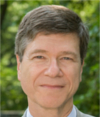 This week, hosts Mark Masselli and Margaret Flinter speak with Dr. Jeffrey Sachs, global health thought leader, Professor of Economics and Director of The Earth Institute at Columbia University. Dr. Sachs discusses his work advising the United Nations on the Millennium Development Goals and his new book, The Age of Sustainable Development which looks at the need for a global commitment to ending the causes of poor health around the world.
Music
Mark Masselli: This is Conversations on healthcare. I am Mark Masselli.
Margaret Flinter: A nd I am Margaret Flinte r.
Mark Masselli: Well Margaret we spend so much time focusing on American Healthcare
and the huge transformations underway here. Sometimes we like to aim our lens
globally. So much transformation is happening really around the world.
Margaret Flinter: And while the Affordable Care Act in the rise of tech nology and
medicine is dramatically changing the landscape here the same thing is happening in
China. That country is developing rapidly across the board and they have announced
an initiative to overhaul their nation ’ s healthcare system. That’s going to be a massive
undertaking considering the size of the population.
Mark Masselli: The current system is cobbled. Traditional Chinese medicine combined
with the growing trend of modern medical training.
Margaret Flinter: Well the Chinese government has a nnounced an initiative to
modernize the nation’s health infrastructure. They are planning to double of the number
of the nation’s doctors by 2020 and they have announced a 5 year roadmap to
improving the nation’s healthcare infrastructure planning to put in place the system of
electronic health records, to develop a cloud based system to store all that new
healthcare data and as you can imagine the world’s health industry vendors are lining
up for what’s expected to be a trillion dollar project.
Ma rk Masselli: It may be of interest to see how the Chinese health reform unfolds in the
coming years.
Margaret Flinter: And our guest today is one of the world’s l eading experts on global
health. Dr. Jeffery Sachs is the Director of the Earth Institute at the Columbia University
and Director of the UN’s Millennium Development Goals as well as a new initiative the
sustainable developmental he is a terrific thought leader in this area and we are looki ng
forward to that conversation.
Mark Masselli: Indeed Lori Robertson now stops by as she always does on the
misstatements spoken about health policy in the public domain but no matter what the
topic you can hear all of our shows by going to chcradio.com
Margaret Flinter: And as always if you have comments email us at [email protected]
or find us on Facebook or Twitter because we love to hear from you. We will get to our interview with Dr. Jeffery Sachs in just a moment.
Mark Masselli: But first here is our producer Marianne O’Hare with this week’s headline
news.
Music
Marianne O’Hare: I am Marianne O’Hare with these Healthcare Headlines. Health
coverage and hospitals the Cleveland Clinic calls the ACA a win - win noting since the
pas sage of the Affordable Care Act and two r ounds of open enrollment, the percentage
of uninsured seeking care at that hospital is down significantly 40% in 2 years.
Cleveland Clinic reports its charity care spending is down by about $70 million.
Hospitals officials credited the Federal Law for the improvement due to the expansion
Medic a id eligibility in Ohio. The 40% drops spotlights national trend on how payments
are changing for all providers since the Health Law ruled out. Another staled action in
Congress means more time to guess about the future or the appeal of the SGR. The
(inaudible 02:57) bi partisan deal t and the almost two decades old sustainable growth
rate formula which compensates providers treating Medicare patients. The senate
faile d to act on the Doc Fix before the two week recess and won’t be back in business
th
till April 14 . It’s expected when they return there will be more haggling over
amendments to the bill before final action is taken. And if you are in hospital for any
reas on you are obliged to wear the dreaded hospital gown. The Cleveland Clinic and
several other hospitals around the country are looking at redesigning the traditional
open back flap design saying they are bad for patient moral and can be demoralizing.
Clev el and Clinic has even solicited the talents of designer Diance Von Fostenburg, a
designer of the iconic wrap dress. She has taken that same approach to the hospital
gown. This wrap hospital gown ties in the front is made of softer fabric and comes with
pockets. Early abated testing patient’s uniformly love the new design. I am Marianne
O’Hare with these Healthcare Headlines.
Music
Mark Masselli: We are speaking today with Dr. Jeffery Sachs, Director of the Earth
Institute at the Columbia University. Dr. Sachs is also key advisor to UN General
Secretary Ban Ki - moon on the Millennium Development Goals. It is the record of the
UN sustainable development network. He is the author of several best sellers including
the End of Poverty and the price of civilization. His latest book the Age of Sustainable
Development has just been released and his one numerous distinctions being named
twice to Time Magazine’s list of hundred most influential world leaders here and h e is
U ndergraduate M asters and PhD from Harvard. Dr. Sachs welcome to Conversations
on Healthcare.
Dr. Sachs: Pleasure to be with you .
Margaret Flinter: Great. Jeff you have had an interesting perch at the intersection of
global development and its impact on health and well - being and you have been a key
advisor to numerous countries around the world then help pass to achieve success with
the Millennium De velopment Goals which has a very strong focus on improving global
health with a focus on eliminating preventable maternal and child m ortality in tacking
malaria, HIV and AIDS so we are now at the end of that 15 year old process. Can you
tell our listeners how far we have come in meeting those targets?
Dr. Sachs: It’s been a 15 year period in which many diseases that are an ancient
scourges like malaria have been brought partly under control in which child birth has
become safer, in which the mortality ra tes of young children have declined pretty
significantly around th e world. When we have put the effort into helping disease control
we have gotten good results. I would say the main message of the millennium
development goal period is if you invest in he alth you will get better health. As a result
we have tools that are quite powerful to help peo ple have healthy or safer lives. The big
problem has been that for the poor these tools have been out of reach and the purpose
of the MDGs has been to bring the m into reach.
Margaret Flinter: Well just you are one of the first global economist to put the data
together that illustrates how this absolutely does apply to global economic development.
Your early study showed that in places where scourges like AIDS and malaria were
prevalent economic growth was non - existent. So tell us more about this health wealth
connection.
Dr. Jeffery Sachs: Now imagine regions or countries beseech by pervasive infections
whether its worm infections or repetitive bouts of malaria or HIV AIDS. Well when I was
beginning my work in the number of those countries 20 or 25 years ago I was
completely stunned actually coming from a rich country and with the idea that when
people are sick they go to a doctor. To be in places where when people are sick they
die. Often dying of causes that are treatable for under a buck for example it ’ s shocking.
I started because of that sense of bewilderment I would say 20 years ago to ask myself
the question now what’s the consequence of all of this and began research that you
mentioned on showing just how devastating these epidemics are for economic
development. Well then 50 years ago at the start of this millennium period. I was ask ed
to chair a commission for the World Health Organization on exactly this question and we
found that indeed investing in health it’s obvious from the point of view of helping
impoverish places, get out of the crap of poverty leading to more disease. A lo t of those
ideas were then incorporated in the Millennium Development Goals and in particular in
the creation of new funding institutions like the global fund to fight AIDS, TB and
Malaria. It’s because of that putting in real resources behind good scienc e and good
technology that these diseases come under control. The truth of the matter is that deep
in if the government itself is not one that to one would love there are actual ways to
deliver healthcare that really worked. Polio tremendously down almos t eradicated .
AIDS treatment now up to some more probably around 13 or 14 million people alive
today because they are systematically receiving their medicines. Malaria down by
around 60% deaths so the bottom line is this stuff works. Countries get off t heir backs
when these disease burdens come down economic growth can get started again ,
agricultural productivity can start to rise and this fantastic field of public health can really
deliver.
Mark Masselli: Jeff and your most recent book The Age of Sustainable Development
you start off by providing a framework to understand what sustainable development is
and then explore how we can achieve these goals moving forward. Also it’s a textbook
for anyone interest ed in taking your massive online course but I do want to focus in on
sort of the bigger context to your mission started off with former UN General Secretary
Kofi Annan on the Millennium Development Goals and now with Ban Ki - moon as a
Secretary General you are focusing on sustainable development goals and maybe just
give this larger context of how this is working for our listeners.
Dr. Jeffery Sachs: Sustainable Development says keep your eye on three things, first
the economy, second the help of the socie ty, is society becoming more unequal? So
what is called social inclusion or social capital is the second heart of sustainable
development and then the third don’t let the economy wreck the environment and
unfortunately the world economic system over the l ast quarter century has been turning
out so much pollution, there is so much carbon dioxide coming from burning coal, oil
and gas. I think most people now really understand well we are actually changing the
climate, we are changing the ocean chemistry, we are destroying the habitat of other
spec ies so sustainable developments the idea that we need a holistic approach for our
world economy and that’s why the UN members states a 193 governments in the world
agreed 3 years ago that this coming September the w orld will adopt dual goals that they
will call sustainable development goals or STGs to put sustainable development into the
world’s consciousness. I have written the book the age of sustainable development to
help explain the concept and how it can actua lly be achieved.
Margaret Flinter: You have noted that this work that’s been done over the last 15 years
there really has been this remarkable progress only a very small percentage of the
millions of HIV infected Africans were receiving any kind of effective medical
intervention, malaria infections are on the rise , globally infant mortality was at 12.6
million per year in 1990 maybe highlight some of the interventions as you look back that
brought about the results from that water shed moment when a global commitment was
made to tackle these huge health challenges .
Dr. Jeffery Sachs: For me the AIDS and malaria control efforts have been remarkable
to see from a position in which both diseases were running completely out of control to
a situation wh ere we are really within insight of beating both of those diseases. Malaria
for me has been a vivid example of the potential triumph of public health. Back in 2000
there was almost no control effort and yet the malaria specialist that I talked to back
th en said of course this is a controllable disease. We have insecticide treated and we
have a new first line of medicine that can actually cure it out of mal aria and part of it was
creating a new institution the global fund to fight AIDS, TB and malaria to help finance
the battle. Part of it was to ensure that every household in Africa that needs it and can’t
afford it should get a mosquito so that they would have some protection hundreds of
millions of nets have been distributed. Then the scientist came u p with a better
diagnostic for malaria. It used to be that you needed someone looking through
microscope and that was a very difficult thing to organize to have a trained microscopist
and have the lab equipment and the clinic might be 10 miles away and so forth and then
the clever scientist came up with a rapid diagnostic where just one drop of blood on a
little strip would change color if the person is in fected with malaria. Well all of a sudden
you could now diagnose the disease out in the village in a poor person’s farm and here
are the medicines to treat you. Then came the mobile phone revolution so that you
could now have an outreach worker with the backpack that have the rapid diagnostic
test and the new medicines so a whole system has developed for community based
malaria control. We have seen malaria deaths come down as I mentioned by around
60%, that we should have 100% but we don’t have the fund ing and the organization in
place to really drive it down to zero right now and that’s why I am calling for a scaling up
of our success stories. Its funding community help workers for example who ca n get us
to the 100% cure rate.
Mark Masselli: We are s peaking today with Dr. Jeffery Sachs Director of the Earth
Institute at the Columbia University. Dr. Sachs is also a key advisor to UN Secretary
General Ban Ki - moon on the Millennium Development Goals and he is director of the
UN Sustainable Development N etwork as well as commissioner of ITU UNESCO’s
broadband commission for development and Jeff let’s take a look at the proliferation of
mobile technology in the developing world and it’s not only become a vital tool in filling
enormous gaps in the care delivery system of the developing world. It’s also a vital tool
in economic development as well and while we focus in on healthcare apps we kept a
keen eye on the banking world in Kenya of the M - Pesa the mobile money transfer
platform has been very exciting, how has mobile technology like this enhanced your
work in advancing health for all?
Dr. Jeffery Sachs: For poor peop le isolated in rural areas no banks, no ability to find
transport in an emergency the transformations that’s come with the mobile phone
revolution in my view has been the biggest boost of all to the economic development of
the poorest parts of the world. This is really the leap frog technology. I am convinced
that smart broadband is going to bring education and quality education to the poorest
places in the world. Now they can have the world knowledge if we get a bit organized
for them to have a screen a nd wireless broadband. I am c onvinced that it is going to
transform healthcare delivery and by the way not only in poor countries but in our
countries as well because now you can do regular sensing of blood pressure or some
other health indicator. In poo r countries where there may not be a radiologist anywhere
nearby now with Telemedicine that radiologist could be half way around the world. It
doesn’t matter. The banking which you mentioned M - Pesa came to Kenya before it
came to Manhattan. The Apple pa ys trying to do what Kenyans have been doing for
years which is to easily use their mobile devices as a regular payment systems and for
people who would never step foot in a bank and had no prospect of stepping foot in a
bank they are doing normal banking and electronics payments so it’s exciting and for
me it really is the key for future.
Margaret Flinter: Well Jeff you are just part of an event that happened here in our home
state of Connecticut and in your presentation of the global health and innovation
conference at EL [PH] University you spoke to perhaps one of the greatest threats to
the global health in the coming deca des and that’s climate change. Minority of political
and economic interest continue to run interference on reaching a global consensus and
how best attack of the critical issue, can you outline for us the real threat to global
health as created by climate change?
Dr. Jeffery Sachs: This so crucial that we take some preventative steps at this point to
head off what could be real calamities. I think all of us now almost all of us except
maybe for the CEO of a big oil company that the climate change is real that it is
intensifying heat waves that even these awful cold spells we have had in the northeast
of the United States are related to the derangement of climate coming from the
greenhouse gases that are modern world economy pumps into the atmosphere at huge
amounts. My god we have already raised the world’s temperatures. We have already
instigated more extreme hurricanes and typhoons. We are having more droughts and
heat waves in many places in the world. The thing we haven’t done is address this
problem coherently and the reason we are the tipping point is that the public knows this
is true but the propaganda in some of the corporate press like the Wall Street Journal
unfortunately and the politics in Washington have a prevented action. Here you have
about 70% of Americans saying we should do something but we have a Congress that
is in the hands of a big oil and big coal and I think we are about to make a
breakthrough. The what to do in broad term s is straightforward but not simple and
that’s to change the primary energy sources for the world from the coal, oil and gas to
renewable energy like wi nd and solar power, hydro power. That’s feasible. It is a
charge and a responsibility over a course of two or three decades. It doesn’t sit too
easily with the dig oil because it means using less of what they produce. We would
actually not only have a safer planet, we would have a cleaner air and a higher quality
of life if we make the transition to a low carbon smart energy system but it just means
that some of the old vested interest they have to get out of the way so that we can build
the new economy.
Mark Masselli: We have been speaking today with Dr. Jeffery Sachs, Director of the
Earth Institute at the Columbia University and a key advisor to UN Secretary General
Ban Ki - moon who could also learn about his work by gong to earth.columbi.edu or to
jeffsachs.org. Jeff thank you for the work you do and for joining us on Conversations on
Healthcare.
Dr. Jeffery Sachs: Well really great to be with you. Thanks so much.
Music
Mark Masselli: At Conversations on Healthcare we want our audience to be truly in the
know when it comes to the facts about Healthcare Reform and Policy. Lori Robertson is
an award winning Journalist and Managing Editor of FactCheck.Org a non - partisan,
non - profit consumer advocate for voters that aim to reduce the level of deception in US
politics. Lori what have you got for us this week?
Lori Robertson: Pres ident Obama recently said that the Affordable Care Act is reducing
the overall cost of healthcare including putting “$1800” in people’s pocket but the
President’s $1800 reduction isn’t a reduction in insurance premium but rather it’s the
difference between the cost of the average employers sponsored plan in 2014 and what
the average premium would have been if based on average rate increases from 2000
through 2010. The calculations were done by Whitehouse economic advisors but even
they say the Affordable C are Act isn’t responsible for the full $1800 difference.
Employer’s sponsored premium have been growing at low rates for the past few years
and the Whitehouse Council of economic advisors look that what premium growth would
have been since 2010 if the gro wth rates had been high as they were in the decade
before. That calculation show the average family premium for employers sponsored
plans would be $1800 more than it actually is but does the ACA get credit for that? As
Obama said it should it could be re sponsible for some of the slower growth but experts
largely attributed to the sluggish economy. The Council of Economic Advisors said “a
significant” fraction of the slowdown in healthcare inflation could be linked to the ACA
but it didn’t say how much? Also the $1800 difference is the total premium amount that
would have been paid by both employers and employee so not all of the $ 1800 would
amount to money in people’s pocket and that’s my FactCheck for this week. I am Lori
Robertson, Managing Editor of factcheck.org.
Margaret Flinter: FactCheck.org is committed to factual accuracy from the country’s
major political players and i s a project of the Anna Bird Public Policy Center at the
University of Pennsylvania. If you have a fact that you would like checked Email us at
CHCradio.com. We will have FactCheck.org Lori Robertson check it out for you here on
Conversations on Healthca re.
Music
Mark Masselli: Each week conversations highlight a bright idea about how to make
w ellness a part of our communities in everyday lives. Depression is extremely common
among Ed lessons in this country but it’s often hard to differentiate between typically
(inaudible 23:05) and a clinical condition that requires more immediate intervention.
Unfortunately, a teen’s level of depression isn’t realized until they take drastic action.
Suicide is the third leading cause of death among 10 to 24 year olds, a population that
almost ubiquitously uses texting as a form of communication.
Nancy Lublin: If you are someone who is in pain, you texted us and then the councilor
on the other side is not working from a phone, they are on a screen that almos t looks
kind of like Facebook or Gmail.
Mark Masselli: Nancy Lublin is founder and CEO or Crisis Text Line an instant texting
service designed to encourage teens in crisis to reach out for help which they receive
instantly. All they have to do is text t he numbers 741 - 741.
Nancy Lublin: When messages come in with certain keywords in them they
automatically get tagged at high risk. If you are at risk for suicide you are automatically
bumped up in the queue and you are like a code red.
Mark Masselli: Since she founded Crisis Text the word has spread like wild fire. They
receive an average of 15,000 text per day from kids experiencing everything from
typical teen dilemmas such as a fight with a boyfriend, to kids contemplating suicide,
those in most da nger are encouraged to take action through a series of channels.
Crisis Text Line an instant age appropriate interventi on available free of charge and
24x7 to give kids in crisis a life line and leave them to help they need. Now that’s a
bright idea.
Mu sic
Margaret Flinter: This is Conversations on Healthcare. I am Margaret Flinter.
Mark Masselli: And I am Mark Masselli. Peace in Health.
Conversations on Healthcare broadcast from the campus of WESU at Wesleyan
University.
Streaming live at wesufm.org and brought to you by the community health center.