Dr. Eliseo Perez-Stable, Director of NIMHD

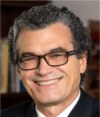 This week, hosts Mark Masselli and Margaret Flinter speak with Dr. Eliseo J. Perez-Stable, Director of the National Institute on Minority Health and Health Disparities at the National Institutes of Health where he oversees the Institute’s efforts to promote research, build infrastructure and support programs that serve to advance minority health as well as eliminate health disparities.
Dr. Eliseo Pérez - Stable – Director of the National Institute of Minority Health and
Health Disparities at the Nat ional Institutes of Health
(Music)
Mark Masselli: This is Conversations on Health Care. I am Mark Masselli.
Margaret Flinter: And I am Margaret Flinter.
Mark Masselli: Well Margaret, another year, another celebration of the legacy of
Dr. Martin Luther King Jr. who se quest f or equality extended to one of the most
basic civil rights , that o f equal access to decent health care for all citizens of this
country.
Margaret Flinter: And health disparit y is still very much a reality in this country
and around the world , though we a re starting to see some progress.
Mark Masselli: Millions of Americans have gained access to health coverage
under the Affordable Care Act - it's not a perfect solution, but we are seeing a
significant shift towards inclusion in the American health care system for citizens.
Margaret Flinter: The Executive Director of the Tennessee Justice Center
predicts that the act will close the racial gap in health coverage and that’s a
prerequisite for eliminating disparities in health care and health status. And we ’re
start ing to see that manifest here , Mark.
Mark Masselli: And in just a few years, we have seen America’s uninsur ed rate
go from as high as 18% , or around 50 million Americans , down to under 10% - a
significant progress has been made, but there is m uch more work to do in
advance of the cause of health equality in this country.
Margaret Flinter: And our guest today is somebody who ha s devoted his
professional , medical and research career to eliminating disparities in health, Dr.
Eliseo Pérez - Stable is the Director of the National Institute of Minority Health and
Health Disparities at the National Institute s of Health where he oversees the
research being conducted on minority health issues and improving the health of
minorities in this country.
Mark Masselli: Lori Robertson, stops by as well , the M anaging Editor of
FactCheck.org, is always on the hunt for misstatements spoken about health
policy in the public domain . You can hear all of our shows by going to
w ww.chcradio.com .
Margaret Flinter: And as always , if you have comments, please e - mail us at
[email protected]
, or find us on Facebook or Twitter because we love to hear
from you. Now we get to our interview wit h Dr. Eliseo Pérez - Stable in just a
moment.
Dr. Eliseo Pérez - Stable – Director of the National Institute of Minority Health and
Health Disparities at the Nat ional Institutes of Health
Mark Masselli: But first, here is our producer Marianne O’Hare with this week’s
Headline News.
(Music)
Marianne O’Hare: I am Marianne O’Hare with these Health Care Headlines.
Meaningful use won’t survive th e year of 2016 according to Andy Slavitt, Acting
Administrator for the Centers of Medicare and Medicaid Services. Practices and
hospitals have struggled to keep pace with meaningful use requirements which
are tie d to performance and use of electronic medi cal records paid for with
government grants. Many health entities warned they were giving up on
meaningful use 3 due to inherent challenges even meeting meaningful use 2
requirements. Slavitt promise d there would be something better to replace
meaningful use , though it's unclear yet what that will be.
O n the heels on the president’s call for a Moonshot for Cancer during his State of
the Union address the National Institute s of Health is announcing plans to launch
a data sharing comm ons for researchers ar ound the nation and the world to more
easily share not just their academic papers, but their data as well. And the
Department of Health and Human Services is seeking input from researchers on
the kinds of Cloud services that would facilitate better sharin g of health research
data.
The Lead Poisoning Crisis in Flint, Michigan continues to unfold , Michigan’s
governor asking for federal disaster aid, the Red Cross has been frantically trying
to keep up with demand for drinking water after it came to light th e cit y’s water
supply had dangerously high levels of lead. Not only have hundreds of
thousands of residents be en exposed to lead in their drinking water for over a
year, but switching to clean water now after months of lead exposure may not be
enough to m itigate the impact on children’s growing brains. The World Health
Organization links lead exposure to permanent developmental deficits in children
who are exposed over a period of time.
And opioid addiction has gained necessary traction as a deadly and c ostly public
health crisis , with deaths from overdose on the rise and few treatment options
available. The FDA has just approved a long - term implant that delivers treatment
to patients for six months. The medicine is delivered to opioid receptors in the
brain , diminishing the cravings without delivering a high. Officials see this six -
month long implantable solution a viable one for those who are on daily
treatments and are doing well at managing their addiction.
I am Marianne O’Hare with these Health Ca re Headlines .
(Music)
Dr. Eliseo Pérez - Stable – Director of the National Institute of Minority Health and
Health Disparities at the Nat ional Institutes of Health
Mark Masselli: W e are speaking today with Eliseo Pérez - Stable, Director of the
National Institute of Minority Health and Health Disparities at the National
Institute s of Health. Prior to joining the NIH, Dr. Pérez - Stable spent 37 years at
UC, San Francisco, serving as Chief of the Division of General Internal Medicine,
and Director of both the Center for Aging in Diverse Communities and the
Medical Effect iveness Research Center for Diverse Populations. Dr. Pérez -
Stable was elected to the National Academy of Medicine . He earned his M.D. at
the University of Miami School of Medicine, and completed his residency at
UCSF School of Medicine. Dr. Pérez - Stable, welcome to Conversations on
Health Care .
Dr. Eliseo Pérez - Stable: Thank yo u for having me.
Mark Masselli: Yeah, and it's January and as we said Martin Luther King Day
and who once famously said that of all of the forms of injustice, injustice in health
care is the most shocking and in humane and we are a nation in the midst of
transformation of the ir health care systems, but you have spent decades
researching the link between ethnic minority status , income and health
disparities. Could you help our listeners understand how health disparities
impact specific populations and how entrenched these disparities really are
today?
Dr. Eliseo Pérez - Stable: Yes, to understand health and health care disparities,
one has to conceive of the problem as multidimensional. To begin with is the
social determinants of the individual - how poor they are, what kind of education
they had , whe re they lived. The individual’s behavior also influences health
disparities. Then the environment and the family, the place where one lives ,
influences the individual tremendously, and finally, the importance of biology and
how differences in biological mechanisms and how things work in different
individuals has become much more clear over the last 25 years. All of these
things interact with the health system. The big change, of course, in the last six
years has been the Affordable Care Act , which has increased excess . That’s just
one step towards improving or reducing health disparities.
Margaret Flinter: Well, you have analyzed these issues, both as a researcher but
also a practicing internist and from a pretty early juncture in your career, it's clear
that you understood that health disparities are often promulgated by cultural
barriers. And I understand you are Cuban - American immigrant yourself; maybe
you could talk with us about the kinds of barriers that you have identified as most
prevalent across the multitude of minority po pulations that you have studied.
Dr. Eliseo Pérez - Stable: Yes. We have to remember in this era of technology
that medicine and health are really about human interactions, and it is the
cl inician with the patient that is at the fundamental base of health care. Patients
come from a very broad spectrum. Clinicians tend to come from a much more
narrow spectrum. Wealthy people don’t usually become physicians nor do very
Dr. Eliseo Pérez - Stable – Director of the National Institute of Minority Health and
Health Disparities at the Nat ional Institutes of Health
poor peop le have the opportunity to do so. One area of research that I embarked
on was language factors. If the patient and the doctor don’t speak the same
language , communication is impaired . Another more universal one is literacy
and use of jargon. So clinici ans will have the tendency to fall back on the
medical terminology that they learn ed medicine in and use words that patients,
sometimes even well - educated patients , do not understand . Going into even
more sophisticated communication issues is the area of numeracy where we are
using proportions and risks and estimate of events happening that for the
common individual is not very meaningful to say high risk, low risk or to give it a
quantitative amount - a lot of people don’t really grasp those concepts.
An d finally, the whole issue of culture. There are expectations in culture that vary
and acknowledging that or understanding that at least gives one insight. For
example, in some cultures , the distance between people has to be maintained.
In other culture s, it is appropriate and expected that one touch as the physician
has a role in the culture that is of importance .
Mark Masselli: First of all, the larger context is that you have done a lot of
research on a lot of things – 230 peer - reviewed articles ana lyzed everything from
improving health of the minority and underserved populations , to improving
cross - cultural communication skills among health care professionals, and how do
we go about improving the ability of our primary care providers to have dialog u e
that is relev ant with the population? What has your research shown?
Dr. Eliseo Pérez - Stable: Well, it varies according to the issues Too many times,
we have physicians or clinicians, nurses included, who just speak a little bit of a
language and try to “ get by ”, and this is just – we are beyond that at this point.
We should have professional interpreters in all of those interactions and this is I
think we now have empirical evidence to support that care is compromise d , the
quality is limited. The cl inicians who speak the language fluently should be
evaluated as such so that we know that they are able to do this. On the other
hand, too many times I have seen particularly among younger physicians get
quickly into complex terminology and many, many pat ients are left behind. So
being simpl e is important, and then step it up [0:10:27] they are more informed,
they are more interested in getting more information and then provide that
information - all of this is teachable. And then a final point relates t o the shared
decision making . So frequently a clinician will present to a patient a situation of
here is in favor of doing A and here is what is not in favor of – you want treatment
A or treatment B, here is the evidence, what are your preferences? You k now,
the re a lot of times patient s will come back and say, “Well, you are the doctor,
you are supposed to tell me what to do. ” And so th e balance between that , so
still as a clinician be able to give a recommendation.
So I think this is an area I think t hat we don’t do enough shared decision making
f or many situations , but when we do do it, I think there is still the element that we
Dr. Eliseo Pérez - Stable – Director of the National Institute of Minority Health and
Health Disparities at the Nat ional Institutes of Health
need to say this is my opinion and I think sometimes doctors are hesitant to do
that.
Mark Masselli: You were focused for a long time on certain issues specific to the
Vietnamese and Latino populations in San Francisco, and realize that to
meaningfully impact the health of these populations , that communication had to
move really to the level of effective marketing. So tell u s what did you learn from
the culturally targeted campaigns around public health issues and problems .
Dr. Eliseo Pérez - Stable: So early on in my research career, we were funded by
the National Institute s of Health, National Cancer Institute , for developi ng
smoking cess ation interv entions for Latinos. I work ed with social scientists and
in the process, w e discovered a number of things related to smoking behavior.
Probably I think the most important was this notion of collective values, for the
Latino Com munity. At the time , this is mid to late 1980s, all of the smoking
cessation literature focused on beh avior change for the individual. B We found
that for the Latino population, they actually had a heighten ed concern about the
collective values . So quitt ing for your children ’s sake, for your family ’s sake, and
worrying about having bad breath, and not looking good, and which fit with a
Latino cultural script that had been described by social psychologists called
Simpatia, of wanting to [please 0:12:51.4 ]. My colleagues worked on the
Vietnamese Community, used what we ha d discovered in Latino and applied it to
the Vietnamese Community, and found very similar patterns in that community
with , I think they also used the terminology of health is gold , in Vietn am, health
being like gold, and it became the marker of their whole program, which
continues to this day . And similar kind of principals were applied to things like
getting cancer screening tests, but also needing t o have access, where we now
begi n to int e ract with the healthcare system and being able to have to pay for it
or have a place to go or have insurance to cover it .
So I think the messaging may need to be adapted or tailored to the population,
and some level of tailoring has become now a standard approach.
Mark Masselli: We are speaking today with Dr. Eliseo Pérez - Stable who is the
Director of the Nation al Institute of Minority Health and Health Disparities at the
National Institute s of Health , where his focus is on supporting research to
improv e minority health, as well as eliminating health disparities . Prior to joining
the NIH, Dr. Pérez - Stable spent 37 years at UC San Francisco, as Chief of the
division of General Internal Medicine and Director of both the Center for Aging in
Diverse Communi ties, and the Medical Effectiveness Research Center for
Diverse Populations. Dr. Pérez - Stable, you focus much of your research on how
to improve care and eliminate health disparities, not only in the U nited States, but
in many Latin - American countries. Y ou are talking earlier about where you live is
a good indicator of how your health might be [0:14:40] i s there an analogous
health equity index measure in Latin America in the context of how well they are,
Dr. Eliseo Pérez - Stable – Director of the National Institute of Minority Health and
Health Disparities at the Nat ional Institutes of Health
and how does disparity play out in those regions a nd how are you able to make
an impact in places like Argentina.
Dr. Eliseo Pérez - Stable: Yes I would say that as the global health become s
better across the entire spectrum, importance of place is heightened . All of Latin
America is what we would call m iddle income . A couple of them are emerging -
Brazil and Argentina in particular – Chile as well, emerging economies that are
actually upper middle income . So once you reach that level then the global
health pro blems go beyond childhood diseases of immun ization or infant diarrhea
or respiratory infections . Now these may still be problems, but they are much
better managed, and in fact you look at Latin America and what are the leading
causes of death . Well they have heart attacks , cancer and stroke – sam e as the
United States.
So in Argentina there are tremendous regional variations . Buenos Aires is a
grand capital with a large population, with the kind of problems that we would
expect in Washington D.C. We did work in the very northwest corner of
Ar gentina in a province called Jujuy, which is about 70% indigenous, a generally
poor area, and we worked with adolescen t youth s , in a tobacco project, and
discovered a couple of things.
Well first the patterns of transitions from non - smoker to smoker among these
youths are not that dissimilar from what they are in the populations th at have
been studied in the United States. The rates were as high or higher with the
typical more boys than girls smoking , and some of the issues such as depression
and risk - tak ing behavior or attitudes pla ying a role – very little influence of
parents and sm oking, and much more important influence of peer s , where you
perceive your peers to be.
We did [not 0:16:42 ] use the model of health disparities and diversity that we
have l earned in the US, by asking about race ethnicity and found that youth were
able to say, well I am indigenous, I am of Indian background , of native
background. Or I am mixed, or I am white European . And the traditional pattern
has been that the indigenous Americans have been the ones who have been
discriminated against and held down historically . So I think this was a
tremendously useful project to carry out and learn about. Because the diversity
in Latin America, as a mixed population of three different continent al origins , is
really quite remarkable, and it represents a unique group to study and learn from.
Margaret Flinter: Well Dr. Pérez - Stable , you have won many accolades for many
things in your career, but certainly you have been no ted as an extra ordinary
teacher, and won the highest awards for medical teaching at the University of
San Francisco School of Medicine . You’re obviously passionate about inspiring
the next generation of people who will provide healthcare , which is something we
certainly share, and I wonder if you would comment on how modern health
professions ’ training is being tran sformed to address these issues of disparities
Dr. Eliseo Pérez - Stable – Director of the National Institute of Minority Health and
Health Disparities at the Nat ional Institutes of Health
and to develop the competencies needed to provide culturally competent care
and how are you advancing that work and those ideas at the National Institute for
Minority Health and Health Disparities.
Dr. Eliseo Pérez - Stable: Because NIMHD is focused on advancing research
issues , this is not at the top of our agenda . We are promoting a diverse scientific
work force . There is a large investment made by NIH, led by Dr. Collins , called
the Bill Program to enhance the pipeline . I am concerned that in 20 years the
population of the United States will be - almost half will be non - white, and that the
professional work forc e is lagging way behind. On the physician front, only about
10 % or 1 2% of entering medical students in 2015, self - identified as not being
white. We cannot be so different than the population – not proportional t o the
population, I think that may be setti ng the bar too high, but we need to move it in
the right direction. On the scientific workforce we face similar challenges, and
this is from basic science, biology , research in the laboratory, to population
science and behavioral and clinical science . So I think these are front and
center for the NIH. I will note that the NIH did recruit and establish an office , a
Chief Officer of Diversity, and recruited Hannah Valantine from Stanford to
assume that role.
So she has been in her job now for little over a year and we have worked
together on a couple of projects , and I look forward to continu ing to work with her
on th ese critically important issues.
Mark Masselli: We have been speaking today with Dr. Eliseo Pérez - Stable ,.
Director of the National Instit ute from Minority Health and Health Disparities at
the National Institute s of Health. You can learn more about their work by going
to nimhdnih.gov .
Dr. Pérez - Stable, thank you so much for joining us on Conversations on
Healthcare.
Dr. Eliseo Pérez - Sta ble: Thank you very much.
(Music)
Mark Masselli: At Conversations on Health Care, we want our audience to be
truly in the know when it comes to the facts about health care reform and policy.
Lori Robertson is an award - winning journalist and managing e ditor of
FactCheck.org, a nonpartisan, nonprofit consumer advocate for voters that aim to
reduce the level of deception in US politics. Lori, what have you got for us this
week?
Lori Robertson: In President Obama’s final State of the Union address, he
r epeated his now years ’ long claim of crediting the Affordable Care Act for a
slow down in National Healthcare spending . But economists have linked the
Dr. Eliseo Pérez - Stable – Director of the National Institute of Minority Health and
Health Disparities at the Nat ional Institutes of Health
slower spending growth mainly to the econom y. In fact the growth rate jumped in
2014 when the law ’s cove rage provisions were implemented. Obama said that
under the ACA “ nearly 1 8 million people have gained coverage so far, and in the
process healthcare inflation has s lowed. Health care spending has grown at
historically low rate s in recent years, but the s low down started in 2009, a year
before the ACA was signed into law. From 2009 to 2012, total national health
care expenditures, rose at rates around 4% per year and they dipped as low as
2.9% in 2013 . For 2014 a year in which the major coverage provision s of the law
went into effect , health care spending growth jumped up to 5.3% . Experts have
said the recent lower rates of growth have been largely a reflection of th e
sluggish economy . That comes from the non - profit Kaiser Family Foundation
and experts w ith the Centers for Medicare and Medicaid Services who compiled
the annual health care spending statistics. CMS ’ s expert said in 2014 that the
ACA had had a minimal impact . They estimated an average growth of 6% per
year for about a decade starting in 20 15 largely as a result of the continued
implementation of the ACA coverage expansion and the aging of the population.
That’s my fact check for this week. I'm Lori Robertson, Managing Editor of
FactCheck.org.
Margaret Flinter: FactCheck.org is committed to factual acc uracy from the
country’ s major political players and is a project of the Annenberg Public Policy
Center at the University of Pennsylvania. If you have a fact that you would like
checked, email us at w ww.chcradio.com , we will have FactCheck.org ’ s Lori
Robertson check it out for you here on Conversations on Health Care.
(Music)
Margaret Flinter: Each week Conversations highlights a bright idea about how to
make wellness a part of our communities and everyday lives. When Chef Karl
Guggenmos grew up as a kid in post war Germany, he lived on a diet of organic
and locally grown foods. Now he is the Dean of the Culinary Arts Program at
Johnson & Wales University in Rhode Island, and he realized that he ha s a
responsibility to teach the next generation of chefs how vital natural and simple
ingredients are , not just to creating good food, but to the health of the population
as well. He teamed up with a Professor of Medicine at Tulane University Medical
Scho ol in New Orleans, and together they created what they believe is the first
course in Culinary Medicine in the United States, teaching chefs, and fourth year
medical students, how to understand the synergy between healthy eating, good
food, and good health .
Chef Karl Guggenmos : Our students are actually going to Tulane Medical
School for an interns hip, and they work side by side with medical students and
physicians , using an evidence - based approach to this whole idea of culinary
medicine rather than anecd otal.
Dr. Eliseo Pérez - Stable – Director of the National Institute of Minority Health and
Health Disparities at the Nat ional Institutes of Health
Margaret Flinter: So in addition to learning knife skills, sauté and poaching
techniques, fourth year medical students are given a lesson in food pairings,
learning which foods are most poised to f o ster goo d health, and to combat
obesity in their f uture patients ’ lives.
Chef Karl Guggenmos : They identify ingredients as to their relationship to
health, they then start basic introduction to cooking - from knife skills, to basically
how to sauté, how to poach, how to roast and then they have to do re search, and
our students are there helping and being part of this whole program.
Margaret Flinter: A dean of a reputable culinary program teaming up with a
medical school to train future doctors armed with the skills and information to
assist their patie nts in healthier eating, fostering the development of healt h
conscious chefs who are trained to feed the next generation well with foods that
can prevent obesity, now that’s a bright idea.
(Music)
Margaret Flinter: This is Conversations on Health Care. I'm Margaret Flinter.
Mark Masselli: And I'm Mark Masselli - peace and health.
Conversations on Health Care, broadcast from the campus of WESU at
Wesleyan University, streaming live at www.wesufm.org and brought t o you by
the Community Health Center.