Community Health Center Legends Richard Bohrer & James W. Hunt, Jr.: Lessons for Today
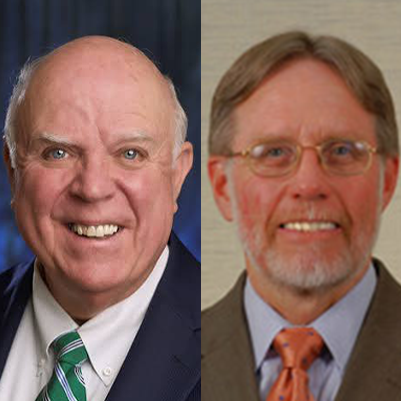
This week is the 17th anniversary of our first “Conversations on Health Care” and our guests have been part of the community health center movement before we even started our interviews.
They have the battle scars that prove they know how to fight and win on behalf of community health centers. Now, they’re rallying the ranks and encouraging them to take on new challenges.
The guests are:
* Rear Admiral, U.S. Public Health Service (ret.), Richard Bohrer, former director of the federal Health Center Program
* James W. Hunt, Jr., Ph.D., former president and CEO, Massachusetts League of Community Health Centers
The latest data show that nearly 1 in 7 Americans, including 1 in 3 in rural America, has relied on community health centers in recent years. But Medicaid cuts threaten their viability.
Bohrer and Hunt join hosts Mark Masselli and Margaret Flinter to explain how they beat back funding threats in the 1980s and how the movement should handle inevitable leadership and operational transitions.
Hunt also discusses his new book, “If You’ve Seen One…,” which covers his six decades of effort to expand access to community health centers.
(00:00)
[instrumental music plays]
Mark Masselli (00:04)
Our guests have played critical roles in the growth and survival of community health centers. They're joining us
to share insights from the battles they've won and give us advice about the challenges ahead.
Richard Bohrer (00:14)
Had health centers not been able to meet that challenge and beat it, okay, again, we wouldn't be talking like we
are today.
Margaret Flinter (00:26)
Our guests today, James Hunt, who led the Massachusetts League of Community Health Centers for over 40
years and is the author of a new book about the movement, and Richard "D ic k" Bohrer , rear admiral and
assistant surgeon general, retired, who directed the Federal Community Health Center Program for over 20 years
and later worked with the National Association of Community Health Centers.
James Hunt (00:50)
We've got 26 health centers in Boston. We've got 26 CEOs. We've got 26 CMOs, 26 CIOs and on and on. And
you say, "Why don't you do something of blending all these health centers together?" And I said, "Well, there's
not a compelling interest to do so, and boards and governance would get in the way." That may be pushed aside.
Margaret (01:10)
This is "Conversations on Health C are."
Mark (01:23)
Well, Jim and D ic k, it's great to have both of you join us on "Conversations on Health C are."
James (01:28)
Thank you, Mark. Thank you, Margaret.
Mark (01:31)
Yeah, great. Jim, what a great book. Just really enjoyed. So many great stories in there. You're a great
storytelle r. I was thinking, Margaret, if he'd written the book maybe 10 years ago, "In the Room Where It
Happened" might have been the title for this because there were so many great opportunities to see and hear
about what was happening in the background. But the title is, "If You've Seen One..." Jim, maybe just shine a
light on the title.
James (02:01)
Well, one of the things that has happened over the past 60 years in the community health center movement, and
through Dick and the bureau and now Tonya Bowers, we were able to formulate strategies that provided a
bucket of services across the spectrum of health centers. But when you started visiting health centers, as I know
all of us have, we've seen that health centers reflect the needs of those communities as wel l, and every one of
them is different. So, if you've seen one community health center, you've seen one community health center.
Margaret (02:33)
That's so interesting, because I think it's often interpreted in the other direction that you can't draw conclusions
about quality. But in fact, I would agree with you, and especially over the last 20 years or so - ... there's much
more consistency of excel lence, but unique flavor for sure, Yes reflecting their community. But also, Jim, your
book's thesis is that community health centers are an indispensable but also may be an endangered part of the
healthcare system. So, share with us, how do you see health centers navigating what is coming up, which is the
enormous Medicaid cuts?
James (03:08)
Yeah, 60 years of struggle and growth within that struggle, and survival for many of the health centers that
started all the way back to the days of the Office of Ec onomic Opportunity, which by the way, reported to the
Justice Department, which was headed at the time by Robert F. Kennedy Senior. Not to say that that has a
reflection on Robert F. Kennedy Jr., but his dad was one of the people responsible for the Office of Economic
Opportunity and the growth of health centers, which were seen as a long - term investment. Yet every
administration, and Dick can attest to this, every administration has a different approach, has different set of
priorities, and health centers have been able to respond to those over time.
Mark (03:55)
Well, that's great. Margaret, in looking at Dick's story, who we know so well, it's covered such a range, sort of a
rollercoaster from the lows to the highs. And, Dick , you were there when the Rea gan administration proposed
the block grant, 25% reduction, send all this back to the state. And then you were also there when George W.
Bush said, "Let's double the investment in it." But I think, given the times, that our audience would like to hear
abou t the early '80s. How did we get through that fight?
Richard (04:30)
So, I want to go back to, Margaret, your question and Jim's response and just remind folks, okay. I don't think
the program has ever not had issues and challenges. Remember, okay, that O ffice of Economic Opportunity
program, that was a demonstration program. That was supposed to end, okay, and it didn't, okay. And we're here
today talking about a program that went from a demonstration to being a critical piece in the overall healthcare
of our country. The challenge of block grants, okay, which was a priority, especially the first administration of
Ronald Reagan. They came in and that was what they wanted to do. And as Jimmy mentions in the book, okay,
while it was talking about pushing it to states, getting it out of Washington, it was also to save money. It was to
cut the funding. And certainly, that was another one that had health centers not been able to meet that challenge
and beat it, okay, again, we wouldn't be talking like we are tod ay. As I think back to those critical first 18
months of the Reagan administration, there were a couple things that made the survival of the program happen.
One, teamwork. This was not about one person. This was about a lot of people, some very publicly sp eaking,
others quietly working behind the scenes, but it was about teamwork. National Association of Community
Health Centers was critical. They were public facing. They were out there talking about what would happen.
However, they would not have driven th at message home had it not been for real people in those communities
that Jimmy mentioned, fighting as hard as they could, okay. There was a core group of people in West Virginia
who stood up and to challenge and really made the path possible to come up wi th a piece of legislation that
would be very hard to implement. And then, this has always, fortunately, been a program that's been able to sell
itself, and I mean that positively. Sell itself to Republicans and to Democrats. Had this not already started in the
'80s to be seen as bipartisan, because the votes back then were just like the votes are now. One party controls all
three branches of government, House, Senate, White House. So, it took people from the Republican side
accepting that, wait a minute, th is program can't just be let go. And then finally, and golly, you guys know as
well as I do, because we've talked about my final point, okay. Health centers were also in a position where we
had data, and we were able to take that data and put it into actio nable information. The sad thing when I was in
my position in government was to watch other programs, who I think were powerful programs, but
unfortunately, had a real struggle to make the case of why they were valuable, okay. I think that - The
information that had been collected about health centers, and this goes now to the people quietly on the inside
and were able then to get it before decision and policy makers.
Mark (09:19)
You mentioned West Virginia. Who the heck were the Mountain Mamas?
James (09 :24)
They were board members and executive directors from rural West Virginia with Jay Rockefeller as a
Democratic governor and a House of Representatives that was leaning toward the block grants. The Mountain
Mamas were set loose on the West Virginia Stat e House along with NAC at their side and made a very strong
case. It's interesting because at the time, as the transitioning of the Senate went back to the Republican Party in
the mid - '80s, we went to Senator Kennedy and complained, National Association an d my organization, the Mass
League, went to Senator Kennedy and complained, and he said, "Well, have you looked at Senator Hatch's
committee? What about Lowell Weicker from Connecticut, and what about Senator Stafford from Vermont?
They are two big health center supporters. Go get them to go talk to Senator Hatch." And they did that, and
Hatch became more of a champion than an adversary in the middle of the Reagan presidency. So that
bipartisanship that Dick spoke of and the strength of the data really save d the day in the '80s, as well as strong
grassroots advocacy on the ground.
Margaret (10:46)
Well, the two of you are invoking sort of images in my mind of some other heroes in the movement. We talked
about that original demonstration grant, and of course , can't talk about health centers without mentioning Jack
Geiger.
Mark (10:58)
Jack Geiger.
Margaret (10:59)
We talked about West Virginia. We just had colleagues down at Craig Robertson's retirement party in West
Virginia, and the story of health center s could also be the story of people who took on heroic roles, and Dick ,
you personally and professionally really had to survive that budget battle back during the Reagan
administration. In today's Washington, we often think that if you disagree with electe d leadership, you're going
to be marginalized and dismissed, but we really haven't seen that happen with health centers up to this point. I
think there's been a real appreciation of the work of health centers. What's your take on the current situation in
t erms of support for community health centers in the administration?
Richard (11:45)
I think… Okay. Good news, bad news. The good news is I really do believe that the agency is in support of
health centers. I believe that Administrator Engels has grown to understand what health centers are and is an
advocate, and supportive of them. Now, he has a j ob, and he has a boss and whatever, but that's important. I
think that if you look at, let's just call it the bureau, and it's not that called a bureau anymore, I know that. Okay.
But it's really interesting, as I was thinking about it this afternoon, it's really interesting to look back at the
leadership team at the bureau level. I'll start with Ed Martin, and then I'll go to Marilyn Gaston, then I'll go to
Bill Hobson, and along the way, eventually, I'll get to Jim Macrae. Okay. And then now Tonya Bowers. And
just as those examples go, what was so, I think, important, okay, was that four of them had the beginning of
their public health careers in health centers. Ed in the Bronx, Marilyn in Cincinnati, Bill in Seattle, and Tonya
had a cup of coffee in Conne cticut. The importance of having people in leadership positions that understand the
program is critical. However, they've got to have a team that provides them with the ability to find their way
through agencies, bureaucracies, and if you look back again a t the people who were in those leadership roles in
the bureau, they had strong people who understood how government worked. You had the person who had been
there in the city or in the rural community, wherever, but they also were coupled with people who un derstood
government. So, what worries me today is that we'll see government go one way or the other. It will not have the
counterbalance of the people who can understand communities, understand programs, and this is not just health
centers, this is across the board. You'll have either none of them or all of them. And that's something I hope
doesn't happen.
Mark (15:05)
Jim, I was just - Margaret was just mentioning Jack Geiger, and I think it might be illuminating for our listeners
to hear a little bit abou t those two for health centers. And I do want to give a shout - out to you because you really
identify in your book, focusing on East Boston, Denver, Waianae, Miles Square. You really do a nice job of
really showing some of the history and the like. I will t ake a moment as a 20 - year - old in January 1972 to be in
the Shoreham Hotel with a whole group of people who were starting free clinics. But the interesting thing is so
many of them are large players now in the system, AltaMed, Sea Mar, El Rio, Fenway, San Y sidro, the free
health clinic movement, which really attracted people for ideological reasons. They were able to plant the seed
there, but the health center movement really watered the seed and made it happen. But across the country, there
were a lot of di fferent roots that all came up in the movement, but really Jack really got it going along with
Count, really making a huge difference. But tell that story because I think it's important to know the history of
how this movement really started.
James (16:27 )
Sure. Well, the OEO under Sergeant Shriver wanted to make some investments, and healthcare was not on the
dance card at all. Geiger was much smarter than most anybody on the planet, and he knew that the experience
that he had had in apartheid South Afric a with Dr. Sidney and Emily Kark could be replicated, particularly in
isolated rural areas and in the Deep South, where he really wanted to go. But he was a pragmatist from New
York, and he knew that John W. McCormack was Speaker of the House, and this big giant housing project in
Boston was in the middle of his district, and there were experiments happening of training physicians from Tufts
Medical School in Boston at the Columbia Point housing project, not housing development, housing project,
which was 1 ,503 doors, 5,000 people on an isolated peninsula, today where the Kennedy Library sits, the
Presidential Library, and where the Edward M. Kennedy Institute sits, ironically. So, Geiger and Gibson, Count
Gibson was the head of community health at Tufts Med ical School. They went down to see their friends in the
administration, inside the Shriver's administration, and that's in my book, their names are in my book. And they
said, "Can you give us a $30,000 planning grant to plan a health center at Columbia Poi nt and a place to be
named later in the Deep South?" Because this was during the Freedom Marches in 1964, and they knew that the
governors in Mississippi and any surrounding states would oppose and veto any OEO money coming into their
state. So that's how Columbia Point got to be first. Mound Bayou, Mississippi, was the chosen site for the first
rural health center in the nation, which was part of the same grant that the OEO gave to Tufts. That's why Tufts
was establishing a health center in Mound Bayou, as well as opening a health center in Columbia Point. Gibson
was left behind to do the health center in Boston and elicited a lot of support from the Boston hospitals. And
very quickly, across the city of Boston, there was a very envious response to neighbor hoods that had lost their
doctors and wanted one of these things that OEO was putting up at Columbia Point. And meanwhile, back at the
ranch, Geiger recruited, and he wanted to go, John Hatch, who's still with us, who was a social worker at
Columbia Point and at a housing development in South Boston, Massachusetts, to go with him to Mound Bayou
and to basically plant the seed for community health in Mound Bayou, which of course became so much more.
Tom Ward's book, your own book, Tom Ward's book about the r ural, featuring what happened around creating
jobs and doing a meat packing plant and a farm, and a transportation network, and a food co - op, and a school,
and a labor workforce development project, all out of Mound Bayou Health Center, all paid for with O EO funds,
including writing prescriptions for food for undernourished children and families. Wow. Which got Geiger in a
lot of trouble, of course, because they said, "You can't write prescriptions with federal funds." And he said,
"Well, the last time that I saw malnutrition, the cure was food, so I'm going to do it for the whole family, not just
for the individual who's undernourished." So, Geiger was extremely special. I had the grand opportunity of
spending many, many hours with him and hosting him in Bo ston, and then many hours filming him. Someday
that will be released. Great. Michael Curry, my successor at the league, has promised that the hours of filming
we did in Brooklyn in his home while he was in his mid - 90s will someday be produced. We had hoped it would
be produced in a federal special on channel two or on this channel. But that was not to be, because Jack is now
gone. But he was an extraordinarily persuasive and powerful human being, and we would not be here today if it
weren't him and his tena city to go down to Mound Bayou and establish that health center. And just by the way,
if we ever do produce that film, one of my opening questions for Jack was, "So why didn't you really focus on
Medicaid in Moun t Bayou?" And he said, "What's that?"
Mark (20:58)
That's great.
Margaret (20:59)
Typical Jack humor. But I have to say that it's occurred to me on several occasions that Dr. Geiger would really
appreciate the current administration's focus on nutrition and healthy foods. We're always looking for the seam
of opportunity and common ground, and Jack Geiger would have found that one and appreciated it. Dick , let me
ask you. You say in the book that two of your greatest concerns for the health center movement are leadership
succession, and perhaps the weakening of government partnerships with health centers. So, you're a good
strategist. What do you think the strategy is for making progress in these areas?
Richard (21:45)
There are a lot of health centers, okay? They are not easy jobs, okay? Having an MBA is wonderful. Having a
Master of Public Health and be dueling, that's really great, okay? Are you going to get, though, in the trenches?
Are you going to see what happens in communities? Are we doing what we can now to help those men and
women understa nd how this program survived the challenges, how it is what it is today, and their role, okay, to
pass the torch to them? So that's the first thing. But for the second point, my concern, okay, and you guys talked
about it, okay, when you asked that questio n, okay, about people within government being able to comfortably
speak, okay, and what have you, okay? I worry that the relationship, and I believe that it's very, very important
to make sure that you have clear lines, okay, of where the government begins or the government ends. Where a
national advocacy group begins, okay, and where it ends in that regard with a state organization like. And then
finally, okay, with those, whatever it is today, 600 or more mostly nonprofit, a few publics, okay, that they
k now, okay, what to do. But working in partnership is critical and finding ways to communicate. Some people at
work could be very, very difficult to meet with. Some of them may even be on this broadcast right now. But if
you don't sit and talk with those pe ople, and if you don't try to find out where's that proverbial common ground
okay, doesn't happen. I know. I get it. Okay, it doesn't happen. And the house is about eight miles from the US
Capitol, but we can't let that happen. Mark, if you and I hadn't ha d conversations a long time ago, I don't even
want to admit how long ago. If I just said, "I'm sorry, I'm too busy," or if you said, "I'm not going to deal with
you," then I believe that, and I don't believe just CHC, that's not just CHC, I mean, it's a lo t of people. It was
trying to figure out, okay, all right, you got an issue, you got a need, okay, let's try to find a way to solve it and -
Mark (24:50)
Well, let me ask Jim to sort of pull the thread in, because I really consider you a genius on finding the seam of
connectivity between people to really form, as what Dick was talking about, partnerships. Talk a little bit about
your advice to people to do that, because there's a lot of transitions going on, whether people are, whether, as
you quoted, swall ower or swallowee happening out there. Tell us about opportunities there and also concerns
and ramifications.
James (25:22)
Sure. Well, first of all, we've already talked about this on this call, but relationships get you in the door, and as
Dick has said, data gets you to be able to make the case. So, way back when, it was relationships and begging
for assistance, of which there was strong congressional support, and therefore that was realized. Unfortunately,
that's not enough today. The data mak es it work. When I was preparing for this yesterday, I just happened to
come across an article. It was by happenstance, and the article is written by a woman by the name of Alana
Samuels. And the title of the article is "Stop Saying There's a Nursing Short age." And she's a senior
correspondent for Time Magazine, CNN, The New York Times, and a host of others. And she lays out the data
of why there's no nursing shortage. Now, I know that we in the health center movement are talking about
workforce shortage al l over the place. She lays out the data that tells you why there's no nursing shortage, but
then she takes it the next step. She said, "Nurses that were spending 15 to 30 years in service are now spending
three or four. Burnout is rampant. Salaries are 25% below market in other than huge hospital settings, and so
on." So, she gives you the reasons. And so, I wrote at the bottom of this article for myself, "This is an
opportunity for CHCs." This is an opportunity for CHCs to basically look at workforce condi tions, look at
wages, look at, if you will, burnout, and take steps toward retention and measure it. So, I think there are lots of
opportunities that we have as community health center providers that others don't have, and we also have
opportunities, as Di ck said, to talk to each other. I had probably 30 mergers or acquisitions on my dance card,
and not one of them went forward, not one. And it all broke down to governance issues and, if you will, inter -
community squabbling. Whereas in the case of East Bost on Neighborhood Health Center being approached by
the league and my successor, Michael Curry, and me to look at helping the South End Health Center, that
merger took place, and that was the first successful one that took place in Boston in my entire career . We lost
one health center in Roxbury Comp because we were too slow to provide technical assistance. But the only
merger that was successful was brought about by having people talk to each other, like Dick just said. But as
Margaret said, amid sometimes c haotic policy environments, opportunities emerge. And this article said to me
yesterday that there's an opportunity here in workforce to really examine the data and to basically make strategic
plans to address the shortcomings of the workforce that we have now in order to retain them, in order to provide
access going forward.
Margaret (28:22)
Well, that's a great point, Jim. I read the same article, and I think one of the real successes, and I think both of
you really supported this in your tenures, was th e advancement of health professions training in the health
centers. I think 32 million people get their care in a health center, and they get comprehensive care. What better
place to get your health professions training than in a health center? So, thank y ou for all that. I was going say
50 million do, but that's a fight for another - We argue about that. Your development project with nurse
practitioners is now nationwide renowned. Great. Thank you. And that's been very important to us. Well, I do
think we a ll share a tendency to look for things always to get better, to improve. I think back to the early 2000s
and the health center movement really embracing comprehensive care and bringing in Ed Wagner from the West
Coast to work on improving chronic illness, led in HIV care in the '80s, led in so many things, maternal
improvements. What do you see ahead for health centers? When you put your crystal ball on with all your
experience, what do you see coming up in the next 20 years that you think will be a great t hing for the country
that health centers will do?
Richard (29:40)
A couple come to mind. Okay. Let's talk about those things that are close to home. We're an aging population.
With a few exceptions, providing the care that Medicare - eligible folks need has not been one of the great
accomplishments of health centers. There are exceptions. Okay? But populations are aging. Physicians who
have a clue about geriatric medicine are in short supply. And can health centers find a way -- And it may take
partnering wit h others in their communities. I believe the PACE program is fantastic. Okay? I am definitely a
Medicare - aged person, but I'm not in an MA. Okay? And if you read what happened the last day and a half with
MedPAC, which is the Advisory Committee on Medicare . You would think the only thing they have to talk
about is MA plans and the fact that MA plans don't deliver results and cost more. And so anyway, Margaret, for
me, one of the things would be that looking at an aging population and how do you take what he alth centers
know how to do so well and get to that population and so. That's an example of one thing. So…
Margaret (31:38)
Great.
Mark (31:39)
Jim?
James (31:40)
I see potentially more systems of health centers. Not necessarily fewer health centers, but more systems. I had a
member that was a wonderful human being, and he used to come to me regularly and say, "We've got 26 health
centers in Boston. We've got 26 CEO s. We've got 26 CMOs, 26 CIOs," and on and on and on. And he'd say,
"Why don't you do something of blending all these health centers together?" And I said, "Well, there's not a
compelling interest to do so, and boards and governance would get in the way." That may be pushed aside, and
Dick may disagree with this, but I see bigger systems potentially. And you mentioned, Mark, in one of your
remarks, the giants like Alta Med that could do so much in organizing systems of care that featured community
health ce nters and/or expanded roles for community health centers. We had a member also from Dorchester,
Mass, who used to say, "If we develop relationships with four or five HMOs, we should have any door access is
fine. We're not going to align with one. We'll tak e them all, and any door gains you entrance into the health
center." So, I see potential of innovations rather than just adaption. Uh - huh. We have some health centers, the
ones that are calling me are saying, "How do I lay off half of my staff because I'm going to take this cut?" And I
say, "Well, how can you innovate so that you don't lay off half, that you lay off a very small percentage of your
staff?" So, I see opportunities, and you mentioned it, Margaret, in the nutrition opportunities and the healthy
foods opportunities. I see those opportunities. But as I say in the book, don't get too far out on a limb unless you
know you're going to be successful.
Mark (33:29)
And Jim got through his entire book without one reference to baseball …
Margaret (33:34)
I'm surprised. I was betting money -
Mark (33:35)
…which I was totally shocked. There was one, "Don’t swing at every pitch," at the end. But outside of that, it
wasn't referenced to Dick . We could be here for another couple of hours. We so much appreciate Jim and Dick
for joining us. I really encourage everybody to read Jim's book. It's titled "If You've Seen One…" Remember to
subscribe to our videos on YouTube, find us on Facebook and X. You can also share your thoughts and
comments about this program. Ta ke care and be well.
(34:02)
[instrumental music plays]
Margaret (34:05)
This copyrighted program is produced by "Conversations on Healthcare" and cannot be reproduced or
retransmitted in whole or in part without the express written consent from Communit y Health Center, Inc. The
views expressed by guests are their own, and they do not necessarily reflect the opinion of "Conversations on
Healthcare" or its affiliated entities.
(34:26)
[instrumental music plays out]